



Commercial Truck Accident Lawyer in Brooklyn, NY
We refer high-value commercial auto accident cases involving trucks, company cars, rideshares, and serious injury collisions.
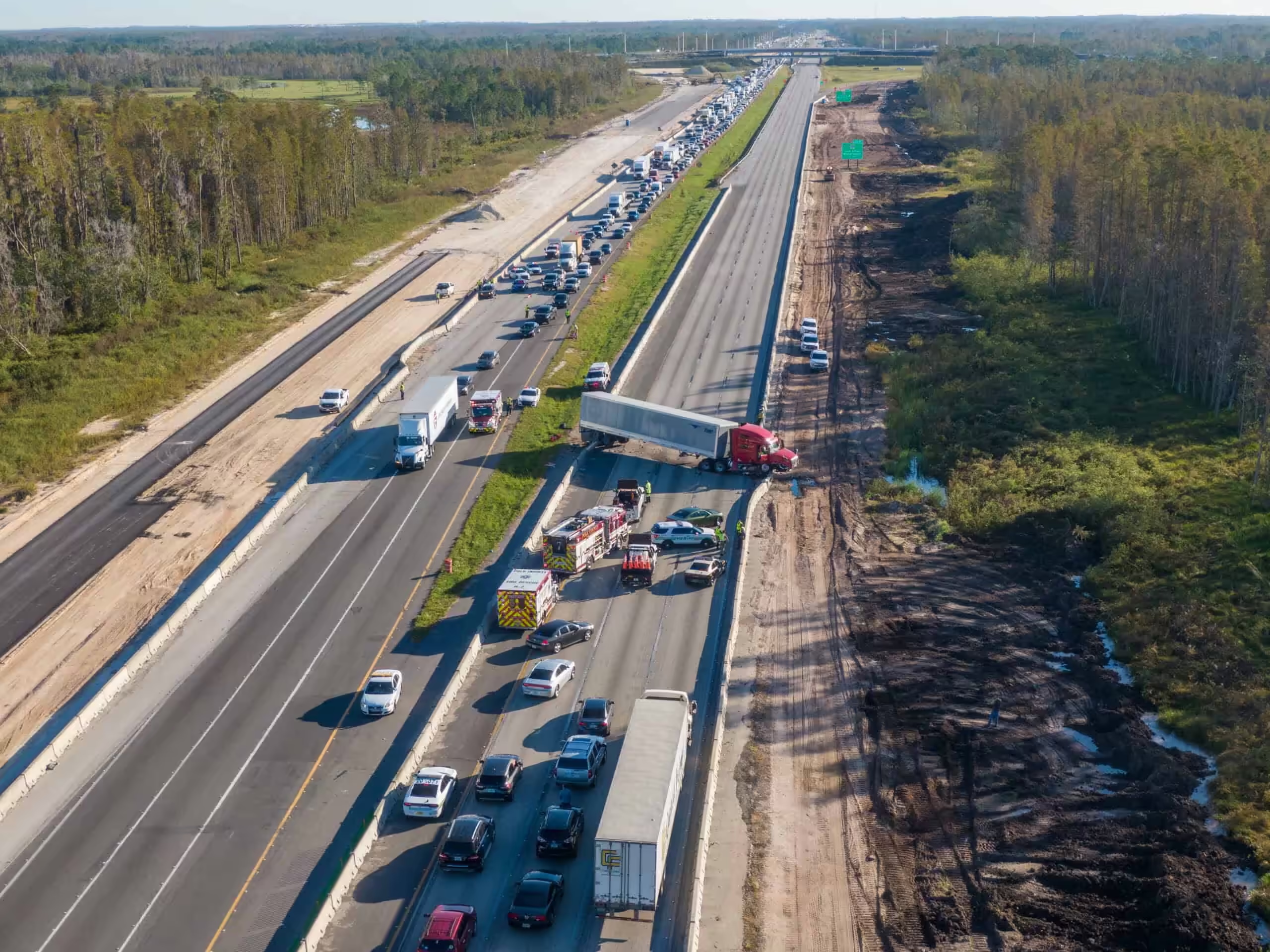
When a Company Vehicle Hits, It’s Not Just an Accident — It’s a Case.
Collisions with commercial trucks, delivery vans, or rideshare vehicles aren’t like typical car accidents. They involve corporate insurers, complex liability, and high financial exposure — and without the right legal team, victims can get buried in red tape.
Michael Brook refers high-value commercial auto accident cases involving 18-wheelers, box trucks, rideshares, and other company-owned vehicles. These cases often include catastrophic injuries, multi-party claims, and aggressive defense tactics from large insurers.
We connect you directly with attorneys who understand how to investigate commercial accidents, preserve black box data, identify negligent drivers or companies, and fight for the compensation you actually deserve — not just what they offer.
If you were seriously injured by a commercial vehicle, don’t settle early or go it alone.
Call Michael Brook. Get referred. Get results.
Michael helped hundreds of injured New Yorkers find the right legal support — with real results and real impact.
Michael helped us understand the legal process and made sure we were matched with a serious attorney who actually cared. We felt supported the whole way through

Have questions about your case or need help finding the right attorney?
Reach out today — consultations are always free, and we’re here to guide you every step of the way.


We’ve answered the most common questions below to help you understand how we connect you with the right attorney.
What Should You Know About a Commercial Truck Accident Case Before Contacting a Lawyer?
A commercial-vehicle collision can involve the driver, motor carrier, vehicle owner, broker, maintenance contractor, cargo loader, or another company. Liability may turn on both ordinary traffic evidence and business records such as dispatch data, electronic logs, inspection files, and maintenance history. Legal advice is especially valuable before short-lived electronic or corporate records are lost and before multiple insurers begin assigning blame.
A useful first consultation about a commercial truck accident claim focuses on what happened, the present medical condition, available evidence, insurance, responsible parties, and every approaching deadline. It should also identify what still needs investigation. No lawyer can responsibly promise an outcome before that review.
Who Typically Needs a Commercial Truck Accident Lawyer in Brooklyn, NY?
People do not need to know whether they have a winning commercial truck accident case before asking for help. A consultation is most useful when the injury or financial impact is meaningful, the facts are disputed, or an insurer or business has begun controlling the information. Typical situations include:
- Occupants, pedestrians, or cyclists seriously injured by a truck, delivery van, bus, or company vehicle.
- Victims in collisions involving driver fatigue, unsafe loading, brake or tire failure, or inadequate supervision.
- Families facing several corporate defendants or insurance policies.
- People whose losses exceed No-Fault benefits or who face a dispute over the sequence of a multi-vehicle crash.
A minor event with a complete recovery may not require litigation, but an early review can still prevent missed notices or lost evidence. The lawyer, not the referral service, decides whether to accept representation after examining the facts.
What Compensation Can a Commercial Truck Accident Claim Cover?
Compensation in a commercial truck accident claim is tied to proven loss, available coverage, responsibility, and the legal theory; it is not a preset amount. Depending on the facts, the claim may address:
- Accident-related medical care, rehabilitation, and qualifying lost earnings under available first-party coverage.
- Past and future income loss, diminished earning capacity, and necessary long-term care proven by the evidence.
- Pain, suffering, disability, and loss of normal activities when legally recoverable.
- Vehicle and personal-property damage, plus other documented out-of-pocket loss.
Bills and diagnoses alone do not establish every category. Medical opinions, wage and tax records, expert projections, liens, insurance limits, comparative fault, and the effect on daily life may all influence value. A lawyer should explain both the gross claim and the deductions that could affect the client's net recovery.
What Legally Counts as Commercial Truck Accident in New York?
A commercial-truck injury claim generally requires proof of a duty of reasonable care, a breach by one or more responsible parties, causation, and damages. Depending on the operation, federal safety rules may help evaluate driving time, vehicle condition, recordkeeping, and carrier practices; the FMCSA hours-of-service summary is one primary source. Employer or owner liability, negligent maintenance, and cargo-loading theories depend on the relationships and evidence in the particular case.
This is a New York overview, not a finding that any particular event meets the definition. The retained attorney must apply the law in force on the relevant dates to the complete evidence and all possible defendants.
What Is the Deadline to File a Commercial Truck Accident Claim in New York?
The ordinary New York limitations period for many negligence-based personal-injury actions is three years under CPLR 214(5), but a public vehicle can trigger much shorter notice rules. No-Fault written notice is generally due within 30 days, and qualifying crashes must be reported to the DMV within 10 days. Corporate electronic logs and vehicle data can disappear long before any statute expires. Prompt counsel can identify defendants, send preservation notices, and calculate every jurisdiction-specific deadline.
A limitations period is not a recommended waiting period. Investigation, notice to insurers, medical documentation, and preservation of video or electronic data often need to begin immediately. Only a lawyer who knows the event date, claimant's age, defendant identities, location, and claim type can calculate the controlling deadline.
What Should You Do Right After a Commercial Truck Accident Incident?
Safety and medical care come first after a possible commercial truck accident incident. Once urgent needs are addressed, take practical steps that create a reliable record without exaggeration or speculation:
- Report the event to the appropriate police, property representative, employer, medical provider, or agency and obtain the report number or a copy.
- Seek timely medical evaluation and accurately describe the mechanism, symptoms, prior conditions, and any change in function.
- Preserve police and reconstruction materials, photographs, witness contacts, electronic logging and engine-control data, dispatch messages, driver qualification records, maintenance and inspection files, cargo documents, medical records, and wage proof.
- Keep every insurer, employer, hospital, or business letter and avoid signing a broad release or giving an improvised recorded statement before understanding its effect.
- Contact qualified counsel early enough to send preservation notices and meet benefit, notice-of-claim, and lawsuit deadlines.
Federal rules summarized by FMCSA make hours-of-service and electronic logging records potentially important, while New York's No-Fault guidance imposes separate benefit deadlines.
These steps preserve information; they do not prove liability by themselves. Do not delay emergency care or create evidence that did not exist.
What Should You Look for When Choosing a Commercial Truck Accident Lawyer?
Choose a lawyer who regularly handles the specific legal and evidentiary issues in commercial truck accident cases, not merely someone who accepts every kind of claim. Ask who will perform the work, how often you will receive updates, and what the lawyer sees as the strongest and weakest facts. Useful selection points include:
- Relevant New York practice and courtroom experience, including matters with comparable injuries and defendants.
- A clear investigation plan and access to appropriate medical, technical, vocational, or financial experts.
- A written fee and expense explanation that you can understand before signing.
- Communication in your preferred language and a realistic discussion of uncertainty, timing, and client responsibilities.
Verify New York admission and public discipline information through the New York court system's attorney resources. Past results may show experience but never guarantee the result of a new case.
What Does Commercial Truck Accident Legal Representation Actually Include?
Legal representation in a commercial truck accident matter is broader than sending a demand letter. The exact scope comes from the retainer, but a full engagement may include:
- Investigating the event, identifying defendants and coverage, preserving evidence, and interviewing witnesses.
- Collecting medical, employment, financial, insurance, and agency records and consulting qualified experts when necessary.
- Preparing benefit applications or the civil claim, communicating with insurers and defense counsel, and negotiating from documented evidence.
- Filing suit on time, conducting discovery and depositions, addressing motions, preparing witnesses, and trying the case if a reasonable resolution is not reached.
The client remains responsible for honest information, medical follow-through, preserving documents, and promptly reporting changes. The attorney should obtain informed client decisions on settlement and major strategy rather than treating the referral as permission to act without consultation.
How Do You Start a Commercial Truck Accident Claim in Brooklyn, NY?
Starting a Brooklyn commercial truck accident matter begins with a confidential fact intake, not a promise of a lawsuit. Michael Brook Attorney Referral first gathers enough information to identify the relevant practice area and a potentially suitable lawyer. Helpful information includes the date and place, people and entities involved, injuries, treatment, reports, insurers, prior communications, and approaching deadlines.
- Call or submit the inquiry form through the official contact page.
- Provide a concise chronology and disclose prior injuries, earlier lawyers, notices, settlements, and all documents already signed.
- Speak with the matched attorney, ask about conflicts and qualifications, and review the written retainer before deciding whether to hire the lawyer.
The referral itself is free and the service is not the law firm that will litigate the case. An attorney-client relationship begins only under the accepting lawyer's engagement process.
How Much Does It Cost to Hire a Commercial Truck Accident Lawyer?
The Michael Brook referral and consultation are free. If the matched lawyer accepts the commercial truck accident matter, a personal-injury engagement is commonly contingent on obtaining a recovery, so there is generally no hourly legal fee paid in advance. In Brooklyn, the Second Department's contingent-fee rule permits specified schedules, including a written agreement not exceeding one-third of the qualifying recovery for many non-medical personal-injury matters.
The retainer must still explain the actual percentage, litigation expenses, whether expenses are deducted before or after the fee, and any costs that could remain the client's responsibility. Medical liens, No-Fault or workers' compensation reimbursement, and case expenses can affect the client's net amount. Read the agreement before signing and ask the lawyer to illustrate the calculation with a simple example.
How Long Does a Commercial Truck Accident Claim Take to Resolve?
Commercial cases can take longer than ordinary car claims because several companies may exchange records and blame one another. Expert reconstruction, safety-rule analysis, medical evaluation, corporate depositions, and motion practice may be needed before a reliable settlement value emerges.
- Initial investigation, insurance and defendant identification, records collection, and deadline protection.
- Medical development and expert evaluation sufficient to understand prognosis, causation, and the full economic effect.
- A documented demand and negotiation, or filing a complaint before the limitations period expires.
- Discovery, depositions, examinations, motions, mediation, settlement approval where required, and trial if necessary.
The sequence is not a guaranteed calendar. Treatment length, court schedules, defendant cooperation, insurance limits, expert availability, and disputed facts can accelerate or extend the matter. A responsible lawyer gives periodic case-specific estimates and explains what is causing any delay.
Why Do Injury Victims in Brooklyn Choose Michael Brook Attorney Referral for Commercial Truck Accident Cases?
Michael Brook Attorney Referral is a matching service, not the law firm that will represent the commercial truck accident claim. Its official About page states that Michael Brook has more than 30 years of referral experience, works with a network of injury attorneys, and offers free consultations in English, Spanish, and Russian. The practical value is a focused introduction to counsel whose practice fits the matter.
- The referral and initial consultation are free, with no fee charged simply for the introduction.
- The online inquiry form can be submitted at any time; live response time depends on availability, and the site says many callers can speak with a lawyer the same day.
- The client can assess the matched lawyer's credentials, communication, fee terms, and proposed approach before signing a retainer.
Thirty years of experience or a prior result does not guarantee acceptance, settlement, or recovery. The retained attorney is independently responsible for legal advice and the case.
What Happens After You Contact Michael Brook Attorney Referral About a Commercial Truck Accident Case?
After a commercial truck accident inquiry, the referral team reviews the basic facts, urgency, location, and type of legal work needed. If the matter appears suitable, the team introduces a lawyer from its network whose practice is relevant. The next stage ordinarily includes:
- A conflict check and a direct attorney consultation about liability, injuries, evidence, deadlines, and available coverage.
- A decision by the lawyer and client whether to proceed, followed by a written retainer and authorizations if both agree.
- Immediate deadline and evidence-preservation work, then collection of records, reports, insurance information, and witness evidence.
- A communication plan explaining who will update the client, what documents are needed, and how major decisions will be made.
A referral is not a guarantee that a lawyer will accept the matter or that a particular outcome will follow. Until an attorney confirms the engagement, the person should continue protecting deadlines and should not assume someone else has filed a notice or claim.