



Construction Accident Lawyer Referral in New York City
We refer high-value construction injury cases, including falls, equipment failure, and third-party or site negligence claims.
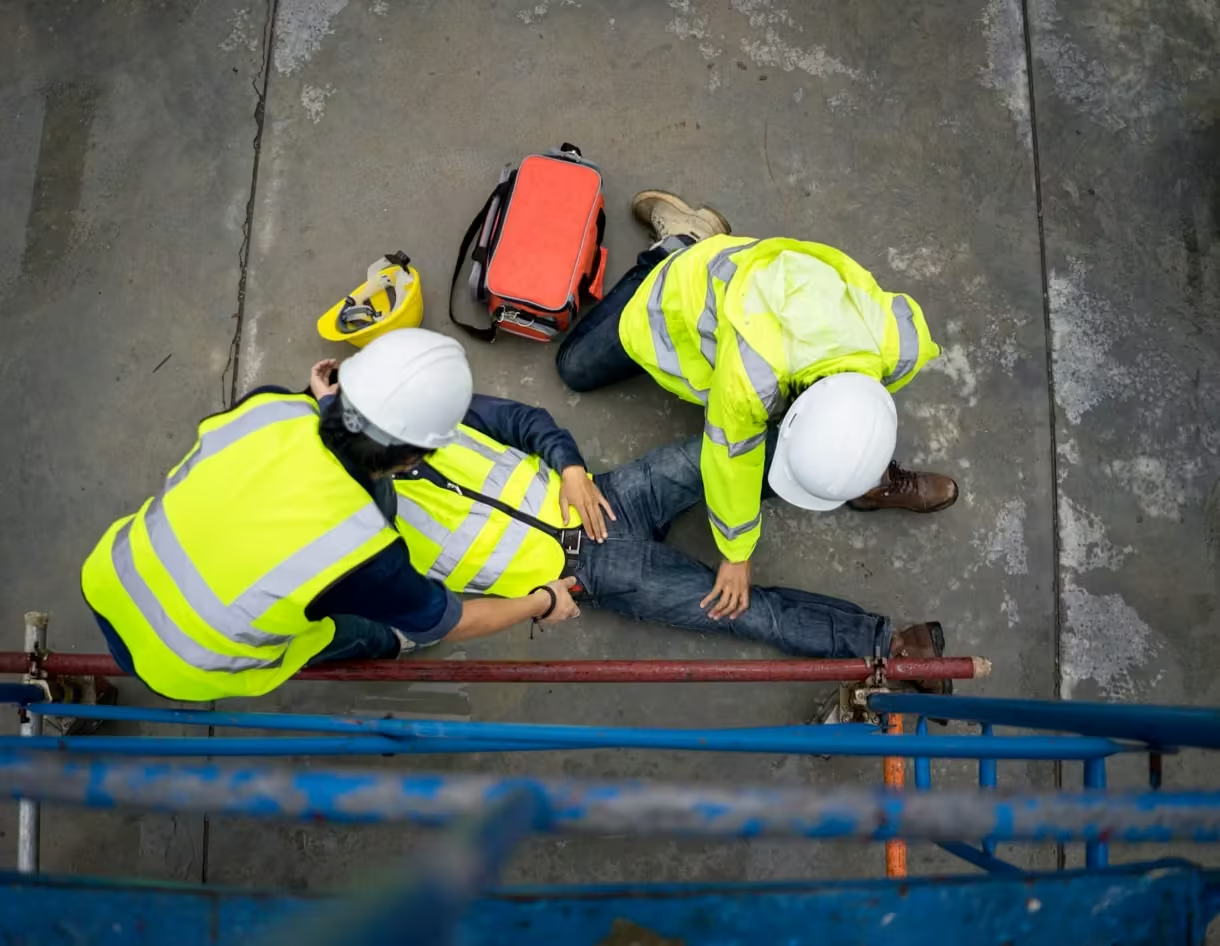
Construction sites are some of the most dangerous places to work — and when something goes wrong, the consequences can be life-changing. Falls from scaffolding, struck-by accidents, collapsing structures, faulty equipment — these are not minor incidents.
Michael Brook connects seriously injured workers with top attorneys who specialize in high-value construction accident cases. Whether you’re dealing with broken bones, spinal trauma, or long-term disability, we’ll refer you to lawyers who know how to handle cases involving third-party liability, Labor Law violations, general contractors, and unsafe work conditions.
These attorneys move fast to protect your rights, preserve evidence, and fight for full compensation — including lost wages, medical costs, and long-term care.
If you’ve been hurt on a construction site and the damage is serious, don’t leave your case in the hands of just anyone.
Call Michael Brook. Get referred. Get results.
Michael helped hundreds of injured New Yorkers find the right legal support — with real results and real impact.
Michael helped us understand the legal process and made sure we were matched with a serious attorney who actually cared. We felt supported the whole way through

Have questions about your case or need help finding the right attorney?
Reach out today — consultations are always free, and we’re here to guide you every step of the way.


We’ve answered the most common questions below to help you understand how we connect you with the right attorney.
What Should You Know About a Construction Accident Case Before Contacting a Lawyer?
A construction injury may create a workers' compensation claim and, in some situations, a separate claim against an owner, general contractor, subcontractor, equipment company, or other third party. New York Labor Law sections 200, 240, and 241 address different duties and do not apply identically to every worker or incident. Legal advice becomes important quickly when there was a height hazard, falling object, unsafe equipment, trench, electrical danger, or serious injury.
A useful first consultation about a construction accident claim focuses on what happened, the present medical condition, available evidence, insurance, responsible parties, and every approaching deadline. It should also identify what still needs investigation. No lawyer can responsibly promise an outcome before that review.
Who Typically Needs a Construction Accident Lawyer in Brooklyn, NY?
People do not need to know whether they have a winning construction accident case before asking for help. A consultation is most useful when the injury or financial impact is meaningful, the facts are disputed, or an insurer or business has begun controlling the information. Typical situations include:
- Workers injured in falls from ladders, scaffolds, roofs, platforms, or other elevation-related events.
- People struck by falling materials or harmed by defective tools, machinery, vehicles, trenches, or site conditions.
- Employees whose workers' compensation benefits are delayed, disputed, or insufficient for their full loss.
- Workers who may have a third-party claim against someone other than their direct employer or co-worker.
A minor event with a complete recovery may not require litigation, but an early review can still prevent missed notices or lost evidence. The lawyer, not the referral service, decides whether to accept representation after examining the facts.
What Compensation Can a Construction Accident Claim Cover?
Compensation in a construction accident claim is tied to proven loss, available coverage, responsibility, and the legal theory; it is not a preset amount. Depending on the facts, the claim may address:
- Workers' compensation medical care and wage-loss or disability benefits when the injury arose from employment.
- Past and future economic losses that are legally recoverable from a responsible third party.
- Pain, suffering, and loss of function in a viable third-party action, because those items are not ordinary workers' compensation benefits.
- Future care, vocational loss, and home or mobility needs supported by medical and economic evidence.
Bills and diagnoses alone do not establish every category. Medical opinions, wage and tax records, expert projections, liens, insurance limits, comparative fault, and the effect on daily life may all influence value. A lawyer should explain both the gross claim and the deductions that could affect the client's net recovery.
What Legally Counts as Construction Accident in New York?
A construction case can rest on ordinary negligence, workers' compensation law, or specific duties under Labor Law sections 200, 240, and 241. Section 200 states a general workplace-safety duty, section 240 addresses specified elevation-related devices and risks, and section 241 addresses construction, excavation, and demolition safety. Coverage, responsible defendants, statutory exceptions, and causation require a fact-specific review of the worker's task, site control, equipment, and accident mechanism.
This is a New York overview, not a finding that any particular event meets the definition. The retained attorney must apply the law in force on the relevant dates to the complete evidence and all possible defendants.
What Is the Deadline to File a Construction Accident Claim in New York?
A New York workers' compensation claimant generally should notify the employer in writing within 30 days and file Form C-3 within two years, as explained by the Workers' Compensation Board. A separate negligence or Labor Law personal-injury action often has a three-year limitations period, while a municipal defendant may require a notice of claim within 90 days. Contractual indemnity, insurance notice, and evidence-preservation issues can arise much sooner. Because multiple systems may apply at once, counsel should calendar each deadline separately.
A limitations period is not a recommended waiting period. Investigation, notice to insurers, medical documentation, and preservation of video or electronic data often need to begin immediately. Only a lawyer who knows the event date, claimant's age, defendant identities, location, and claim type can calculate the controlling deadline.
What Should You Do Right After a Construction Accident Incident?
Safety and medical care come first after a possible construction accident incident. Once urgent needs are addressed, take practical steps that create a reliable record without exaggeration or speculation:
- Report the event to the appropriate police, property representative, employer, medical provider, or agency and obtain the report number or a copy.
- Seek timely medical evaluation and accurately describe the mechanism, symptoms, prior conditions, and any change in function.
- Preserve incident reports, site and equipment photographs, witness and foreman names, employer and contractor identities, safety meeting records, permits, contracts, medical records, wage information, and any OSHA or agency materials.
- Keep every insurer, employer, hospital, or business letter and avoid signing a broad release or giving an improvised recorded statement before understanding its effect.
- Contact qualified counsel early enough to send preservation notices and meet benefit, notice-of-claim, and lawsuit deadlines.
The Workers' Compensation Board toolkit directs an injured worker to obtain treatment, notify the employer, and file a claim; New York's Labor Law supplies additional site-safety rules for qualifying work.
These steps preserve information; they do not prove liability by themselves. Do not delay emergency care or create evidence that did not exist.
What Should You Look for When Choosing a Construction Accident Lawyer?
Choose a lawyer who regularly handles the specific legal and evidentiary issues in construction accident cases, not merely someone who accepts every kind of claim. Ask who will perform the work, how often you will receive updates, and what the lawyer sees as the strongest and weakest facts. Useful selection points include:
- Relevant New York practice and courtroom experience, including matters with comparable injuries and defendants.
- A clear investigation plan and access to appropriate medical, technical, vocational, or financial experts.
- A written fee and expense explanation that you can understand before signing.
- Communication in your preferred language and a realistic discussion of uncertainty, timing, and client responsibilities.
Verify New York admission and public discipline information through the New York court system's attorney resources. Past results may show experience but never guarantee the result of a new case.
What Does Construction Accident Legal Representation Actually Include?
Legal representation in a construction accident matter is broader than sending a demand letter. The exact scope comes from the retainer, but a full engagement may include:
- Investigating the event, identifying defendants and coverage, preserving evidence, and interviewing witnesses.
- Collecting medical, employment, financial, insurance, and agency records and consulting qualified experts when necessary.
- Preparing benefit applications or the civil claim, communicating with insurers and defense counsel, and negotiating from documented evidence.
- Filing suit on time, conducting discovery and depositions, addressing motions, preparing witnesses, and trying the case if a reasonable resolution is not reached.
The client remains responsible for honest information, medical follow-through, preserving documents, and promptly reporting changes. The attorney should obtain informed client decisions on settlement and major strategy rather than treating the referral as permission to act without consultation.
How Do You Start a Construction Accident Claim in Brooklyn, NY?
Starting a Brooklyn construction accident matter begins with a confidential fact intake, not a promise of a lawsuit. Michael Brook Attorney Referral first gathers enough information to identify the relevant practice area and a potentially suitable lawyer. Helpful information includes the date and place, people and entities involved, injuries, treatment, reports, insurers, prior communications, and approaching deadlines.
- Call or submit the inquiry form through the official contact page.
- Provide a concise chronology and disclose prior injuries, earlier lawyers, notices, settlements, and all documents already signed.
- Speak with the matched attorney, ask about conflicts and qualifications, and review the written retainer before deciding whether to hire the lawyer.
The referral itself is free and the service is not the law firm that will litigate the case. An attorney-client relationship begins only under the accepting lawyer's engagement process.
How Much Does It Cost to Hire a Construction Accident Lawyer?
The attorney referral and initial consultation are free. A third-party construction accident lawsuit is often handled under a written contingent-fee agreement, while fees in a workers' compensation proceeding are governed and approved by the Workers' Compensation Board. Workers' Compensation Law section 24 contains the Board fee schedule, so it is inaccurate to treat every work-injury fee as an ordinary one-third contingency.
Ask which claim the lawyer will handle, the percentage or Board-approved method, how litigation expenses are paid, and whether liens or benefit offsets may affect the net recovery. The exact written retainer and applicable tribunal rules control. A free consultation does not create a guarantee of acceptance or recovery.
How Long Does a Construction Accident Claim Take to Resolve?
A workers' compensation claim may begin paying accepted benefits while a third-party case is still being investigated. Complex Labor Law litigation often requires contracts, site records, depositions, engineering or safety experts, medical development, motions, and sometimes trial.
- Initial investigation, insurance and defendant identification, records collection, and deadline protection.
- Medical development and expert evaluation sufficient to understand prognosis, causation, and the full economic effect.
- A documented demand and negotiation, or filing a complaint before the limitations period expires.
- Discovery, depositions, examinations, motions, mediation, settlement approval where required, and trial if necessary.
The sequence is not a guaranteed calendar. Treatment length, court schedules, defendant cooperation, insurance limits, expert availability, and disputed facts can accelerate or extend the matter. A responsible lawyer gives periodic case-specific estimates and explains what is causing any delay.
Why Do Injury Victims in Brooklyn Choose Michael Brook Attorney Referral for Construction Accident Cases?
Michael Brook Attorney Referral is a matching service, not the law firm that will represent the construction accident claim. Its official About page states that Michael Brook has more than 30 years of referral experience, works with a network of injury attorneys, and offers free consultations in English, Spanish, and Russian. The practical value is a focused introduction to counsel whose practice fits the matter.
- The referral and initial consultation are free, with no fee charged simply for the introduction.
- The online inquiry form can be submitted at any time; live response time depends on availability, and the site says many callers can speak with a lawyer the same day.
- The client can assess the matched lawyer's credentials, communication, fee terms, and proposed approach before signing a retainer.
Thirty years of experience or a prior result does not guarantee acceptance, settlement, or recovery. The retained attorney is independently responsible for legal advice and the case.
What Happens After You Contact Michael Brook Attorney Referral About a Construction Accident Case?
After a construction accident inquiry, the referral team reviews the basic facts, urgency, location, and type of legal work needed. If the matter appears suitable, the team introduces a lawyer from its network whose practice is relevant. The next stage ordinarily includes:
- A conflict check and a direct attorney consultation about liability, injuries, evidence, deadlines, and available coverage.
- A decision by the lawyer and client whether to proceed, followed by a written retainer and authorizations if both agree.
- Immediate deadline and evidence-preservation work, then collection of records, reports, insurance information, and witness evidence.
- A communication plan explaining who will update the client, what documents are needed, and how major decisions will be made.
A referral is not a guarantee that a lawyer will accept the matter or that a particular outcome will follow. Until an attorney confirms the engagement, the person should continue protecting deadlines and should not assume someone else has filed a notice or claim.