

Stages and Delays in a NYC Car Accident Settlement
The clearest way to judge a car accident settlement is to pinpoint the current milestone and what has to happen next. A claim waiting on a medical prognosis faces a different obstacle than one waiting on a defendant’s records or signed settlement papers.
The most useful way to assess a car-accident settlement is to identify the current milestone and what must happen next. A claim awaiting a medical prognosis has a different obstacle from one awaiting a defendant’s records or signed settlement papers. A single average cannot explain those differences.
Settlement can occur before a lawsuit, during litigation or after substantial trial preparation. The goal is to understand the evidence, legal risks and payment steps without mistaking an early offer for a complete assessment of the claim.
Which stages determine how long a car accident settlement takes?
Several workstreams usually develop together. Treatment produces information about the injury and recovery. Investigation addresses the collision and the potentially responsible parties. Insurance review identifies coverage and the claims or notices that need attention. Counsel uses those strands to decide when a settlement demand can be meaningfully supported.
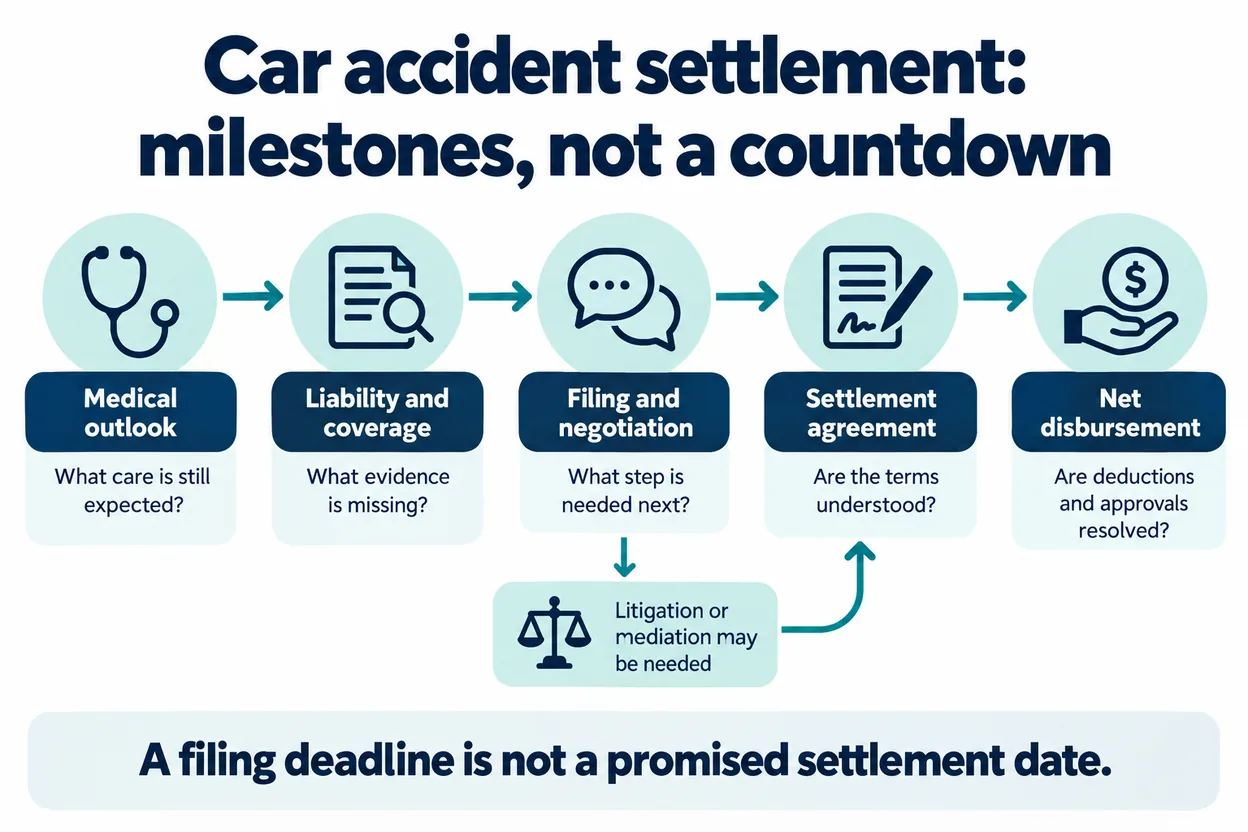
The stages often include:
- Medical assessment: obtaining records, identifying restrictions and clarifying the likely need for further care.
- Liability and coverage investigation: testing the collision account and identifying the parties and available policies.
- Demand and negotiation: presenting a supported claim and evaluating the insurer’s or defendant’s response.
- Litigation when needed: filing and serving the case, exchanging evidence and resolving contested issues through court procedures.
- Agreement and payment: completing enforceable terms, required approvals, payment administration and the client’s net accounting.
The stages can overlap
A lawsuit may need to be filed while treatment continues. Negotiations can continue during discovery, and a new expert opinion may change the settlement position after an earlier demand. The New York courts’ explanation of case stages makes clear that not every case proceeds through every stage to trial.
A filing deadline is a deadline for taking a legal step, not a promise that settlement will occur by then. Waiting for a complete recovery or ongoing insurer discussions should not be assumed to extend the time to bring a claim. Counsel should track filing and notice obligations independently from the negotiation strategy.
Ask for the next decision, not just a predicted date
A useful update identifies what has been completed, what is outstanding and who is responsible for the next action. “We are waiting for the specialist’s prognosis after the scheduled assessment” is more informative than “the case is still pending.” So is an explanation that a coverage question must be resolved before an offer can be evaluated.
Even with a clear plan, the parties may disagree about liability or value. A realistic assessment explains those disagreements and the next step available to address them, without guaranteeing a settlement or completion date.
Why can medical uncertainty or disputed fault delay negotiations?
An injury claim may be difficult to value while important medical questions remain unanswered. The treating team may still be assessing recovery, further treatment or work restrictions. Settling before those questions are understood can leave uncertainty about whether the agreed amount accounts for supported future needs.
That does not mean the entire file should remain inactive until treatment ends. Records can be requested, evidence preserved and legal deadlines addressed while the medical outlook develops. Ask which tasks can proceed now and which genuinely depend on another event.
| Outstanding issue | Why it affects assessment | Useful progress question |
|---|---|---|
| Unclear prognosis | Future care or functional loss may remain uncertain | What medical information is needed, and from whom? |
| Incomplete treatment records | The demand may not show the full course of care | Which records have been requested and followed up? |
| Disputed collision facts | The parties may disagree about responsibility | What evidence could resolve the specific disagreement? |
| Several defendants | Roles and responsibility may overlap or be contested | Which party’s conduct is still being investigated? |
| Coverage dispute | Available payment may be uncertain | What coverage has been confirmed, and what is contested? |
Distinguish necessary investigation from unexplained delay
Necessary evidence gathering has a defined purpose. A request for an imaging report may address a specific medical issue; a deposition may clarify the driver’s account. Ask what the missing material would establish and what follow-up is planned if it does not arrive.
The court discovery process provides methods for obtaining relevant documents and testimony during litigation. Production disputes, objections or incomplete responses can require additional steps. The existence of a request does not mean the evidence has been received or that the other side agrees with its interpretation.
Coverage questions can also be independent of the medical assessment. A supported damages claim may exceed an available policy, or the insurer may contest whether the policy applies to a particular party or activity. Ask counsel to separate the estimated damages from confirmed coverage and collection issues.
Keep your own contribution current: provide requested records, report treatment changes and explain practical barriers to appointments or paperwork. Reliable communication cannot eliminate every delay, but it helps prevent the case from waiting unnecessarily for information within your control.
When might a lawsuit or mediation become part of the process?
A lawsuit may be needed to preserve a claim before the filing deadline, obtain evidence through formal procedures or pursue a dispute that negotiations have not resolved. Filing does not mean that trial is inevitable. It changes the procedural setting and creates additional responsibilities, while settlement discussions may continue.
The New York courts’ case overview describes pleadings, discovery, pretrial preparation and trial. In a personal injury matter, the complaint and responsive papers identify the claims and defenses. Proper service and responses must be addressed before treating the litigation as merely another stage of informal negotiation.
Discovery can change what the parties know
Document exchange, depositions and appropriate expert work may test the collision account, the claimed injuries and the alleged losses. A deposition is sworn testimony; preparation should help you understand the process and give accurate answers, not rehearse an invented version of events.
Expert analysis may be useful where medical causation, future needs or technical accident questions require specialized assessment. The need for an expert depends on the actual issues. More reports do not automatically mean a stronger claim if they do not address the disputed points.
Discovery procedures also involve scheduling, objections and possible court decisions. Court availability and the scope of the dispute can affect progress. Ask whether an upcoming event is a deposition, conference, motion or trial-related deadline and what it is expected to accomplish.
Mediation is an opportunity to negotiate
Mediation can give the parties a structured setting to discuss settlement with a neutral person’s assistance. Its usefulness depends partly on whether the participants have the information and authority needed to negotiate. Attending mediation does not guarantee agreement, and the mediator does not simply award the amount one side requests.
Before a mediation, ask counsel which issues are likely to dominate, what information has been exchanged and how offers will be evaluated. If no agreement is reached, clarify the next litigation step. A failed negotiation may still narrow disagreements, but it should not be described as a completed settlement.
What must happen after an agreement before you receive money?
Agreement on an amount begins a separate completion process. The parties may need to finalize and execute a release and related papers, obtain an approval where required and satisfy payment conditions. Read the release with counsel so you understand which parties and claims it covers and whether any obligations continue afterward.
Check payment requirements rather than accepting an indefinite wait
CPLR §5003-a governs prompt payment of certain settled actions. Its ordinary rule ties payment to tender of specified executed documents, with different provisions for certain public defendants and other exceptions. Counsel should identify the applicable rule, whether the triggering papers have been properly delivered and what response is available if payment is overdue. The date of a verbal offer is not necessarily the statutory trigger.
Some settlements require court approval. For example, CPLR §1207 provides a court process for specified claims involving minors and certain represented persons. Approval and the authorized handling of proceeds must be addressed before assuming that an agreed gross amount is available for immediate unrestricted payment.
Understand the net accounting
After payment is received, fund clearance and proper disbursement still need attention. Applicable liens or reimbursement claims must be identified and addressed, and any unresolved amount held back should have an explained basis. Ask what sum is disputed and whether the undisputed portion can properly be distributed.
The Second Department’s retainer and closing-statement rule illustrates the required distinction between gross recovery, attorney compensation, expenses, payments to others and the client’s net amount. The rule applicable to the particular attorney and matter should be confirmed.
Request a readable statement showing:
- The gross settlement and who paid it.
- The legal fee and the basis used to calculate it.
- Itemized case expenses.
- Liens, reimbursement payments or other authorized deductions.
- The amount payable to you and any sum still reserved, with the reason.
Do not confuse an insurer’s payment to counsel with your final net disbursement. At the same time, a general reference to “paperwork” should be clarified into specific outstanding tasks and applicable payment obligations.
How can Michael Brook help you find counsel when a serious car accident claim stalls?
We can help people with serious crash injuries seek an attorney whose experience fits the unresolved issues. Michael Brook provides referrals. The referred attorney independently reviews the circumstances, decides whether to accept the matter and handles legal work for an accepted case.
When requesting a car accident attorney referral, describe the present stage: treatment, an unanswered demand, disputed coverage, litigation or an agreed settlement awaiting payment. Explain what information you have about the delay rather than assuming that all waiting has the same cause.
If another lawyer already represents you, say so. Bring the engagement agreement, recent correspondence, relevant court notices and any proposed release or accounting to the consultation. A second assessment requires attention to the existing representation and file; a referral alone does not transfer the case or terminate the current engagement.
Ask the evaluating attorney to identify the unresolved issue, the information needed to assess it and any deadline requiring immediate attention. If a new engagement is proposed, clarify who will communicate with existing counsel and how representation, file transfer and any fee issues will be handled.
You can request a free consultation. An independent case review can help clarify the situation, but neither a referral nor a new enquiry guarantees a faster settlement or a particular result.
Conclusion: Which milestones give a realistic picture of your settlement progress?
Judge progress by completed work and identified dependencies. Medical uncertainty, disputed liability and unfinished payment documents call for different next steps. An early offer may arrive before those questions are resolved; its speed does not establish that it reflects the supported value of the claim.
| Milestone | Main dependency | Question to ask |
|---|---|---|
| Medical assessment | Records and a supported outlook | What future needs remain uncertain? |
| Liability and coverage review | Relevant evidence and policy information | Which issue is still disputed? |
| Negotiation or litigation | A supported position and the next procedural step | What action is planned, and who handles it? |
| Settlement documentation | Clear terms and required approvals | Which papers remain outstanding? |
| Net payment | Received funds and an accurate accounting | What is payable now, and what remains unresolved? |
Use court-process guidance to understand what the current legal step can accomplish. Keep treatment and correspondence records current, ask for specific updates and have counsel check payment requirements after an agreement. A reasoned explanation of the next milestone is more useful than an unsupported promise of a completion date.
Sources

Injured in an accident? Michael Brook connects you with top personal injury attorneys who fight to get you the compensation you deserve. Speak with someone today — no cost, no obligation.


After being hit while crossing the street, I had no idea which lawyer to trust. Michael reviewed my situation and connected me with the right attorney immediately.

Michael explained what kind of case I had and referred me to an attorney who handled serious car accidents. That clarity changed everything.

I was injured in a fall and worried it wouldn’t be taken seriously. Michael connected me with an attorney experienced in premises liability cases.

The driver passed away, and I assumed I had no options. Michael explained how insurance works and connected me with an attorney who took action fast.