

Proving Negligence After a Slip and Fall in NYC
A fall can show that you were hurt without showing why another person or business is legally responsible. A premises claim needs evidence linking the condition, the party responsible for the area and the cause of the injury.
A serious fall can establish that you were injured without establishing why another person or business is legally responsible. A premises claim needs evidence connecting the condition, the party responsible for the area and the cause of the injury.
That connection often depends on information that can disappear quickly: a spill is cleaned, a mat is moved or surveillance is overwritten. Preserve what you can safely and obtain advice about the records held by the property owner, occupier or maintenance contractor.
What must you establish to prove negligence after a slip and fall?
Begin with the condition that allegedly caused the fall. Was there a liquid on the floor, a damaged step, an uneven surface or another identifiable hazard? The account should locate the condition and explain how it contributed to the incident. Saying only that an area was dangerous may leave the key causal question unanswered.
Next, determine who had the relevant responsibility for the location. Ownership, occupancy, control and maintenance arrangements can matter. The business whose sign appears at the entrance may not have the same responsibilities as the building owner or a contractor hired for a particular task. Counsel may need leases, agreements and evidence of actual practices to identify the correct legal role.
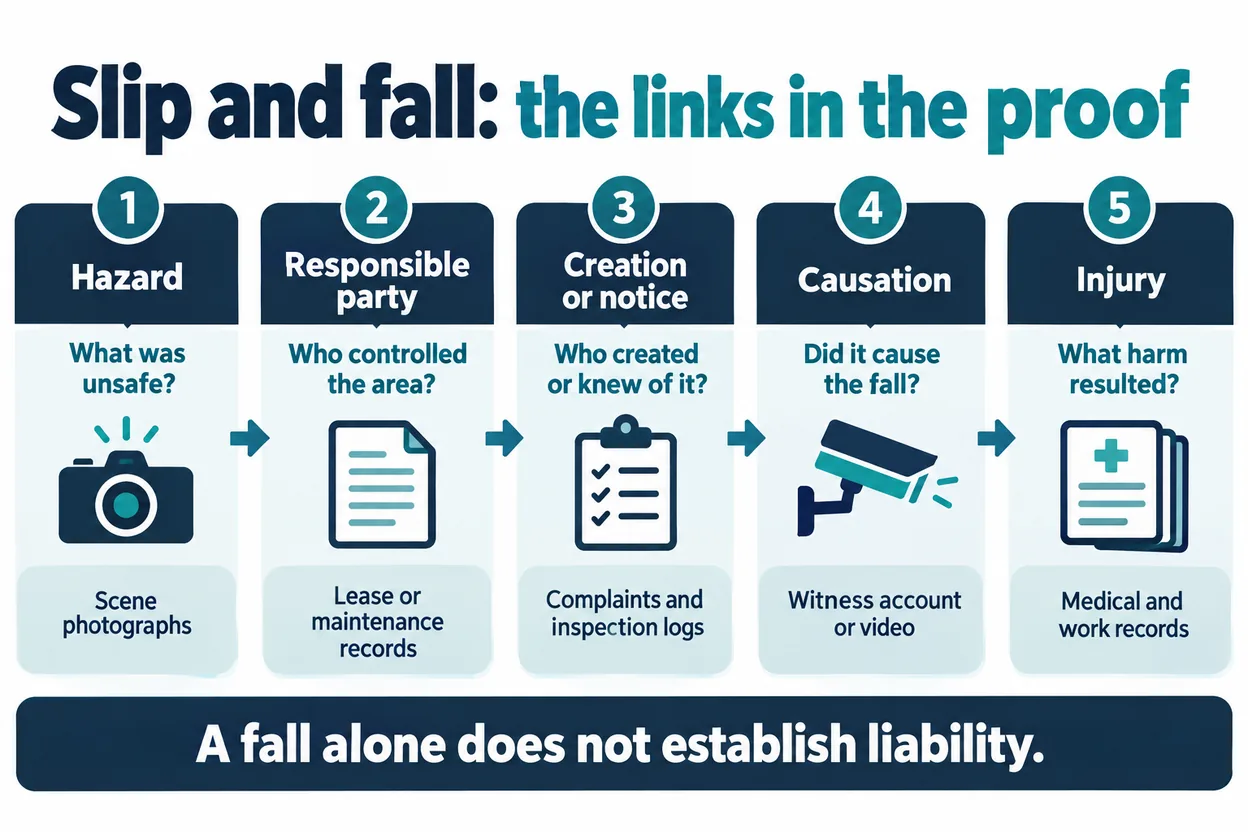
Connect duty, failure and harm
A negligence assessment asks whether the defendant owed an applicable duty, failed to meet it and thereby caused compensable injury. For many unsafe-condition claims, the investigation also addresses whether the defendant created the condition or had actual or constructive notice of it. Those are factual and legal questions, not conclusions supplied by the occurrence of a fall.
The Court of Appeals decision in Gordon v American Museum of Natural History illustrates the importance of evidence about the specific hazard and its duration. General awareness that litter might be present was insufficient to establish constructive notice of the particular paper involved in the fall.
Medical records supply a different part of the claim. They document symptoms, findings, treatment and restrictions. Tell clinicians how you fell and identify uncertainty accurately. Records of an injury do not, by themselves, establish that the property operator knew about a floor condition.
For example, a photograph of a puddle may help establish the condition after the incident. A witness who saw it earlier may help establish duration. An inspection record may address what the responsible business did. The strongest assessment examines how those pieces fit together instead of treating any one as conclusive.
How can you show that the responsible party created or knew about the hazard?
Creation, actual notice and constructive notice describe different possible routes in the assessment. The evidence needed for each differs. A worker spilling liquid while cleaning raises a different question from a customer reporting a spill or a condition remaining visible for a sufficient period before the fall.
| Issue | Evidence that may support it | What still needs to be established |
|---|---|---|
| Creation of the condition | Video, witness observations or work records | Who caused the specific condition and whether the conduct is attributable to the defendant |
| Actual notice | A prior complaint, report or employee communication | Whether the responsible party received notice of the relevant condition before the incident |
| Constructive notice | Evidence of visibility and duration, inspection records or earlier observations | Whether the condition existed long enough to be discovered and remedied under the circumstances |
Focus on the particular condition
In Gordon, the court required a condition to be visible and apparent and present long enough to permit discovery and correction for constructive notice. Speculation about how long the paper had been on the steps did not fill the evidentiary gap. Nor did the presence of other litter elsewhere establish notice of that specific paper.
The practical lesson is to preserve details that distinguish a known possibility from an observed hazard. A witness who says a store is “often messy” gives different information from a witness who saw the same spill at the same location before the fall. A complaint must be examined for its location, subject, recipient and timing.
Test inspection evidence rather than assuming its meaning
An inspection log may identify when an area was checked, by whom and what was observed. Counsel should compare the record with testimony, surveillance and the actual location. A routine policy to inspect floors does not prove that the relevant inspection occurred, while the absence of a particular entry does not automatically resolve every notice question.
Photographs of the condition may help, but appearance alone may not reliably establish duration. A mark, stain or piece of debris needs context before anyone draws a conclusion about how long it was present. Ask the attorney what evidence supports the proposed timing and what remains inference.
Do not attempt to recreate the hazard for photographs. Preserve the original condition where safely possible and identify people or records that can explain its history.
What evidence should you collect before the condition changes?
Get medical assistance first and avoid another fall. If you can safely document the location without disturbing it, take wider photographs showing where the hazard was and closer views showing its characteristics. Include nearby fixed features so a later reviewer can identify the area. Do not climb damaged stairs, enter a restricted area or move an object to make the photograph more dramatic.
Useful material includes:
- The address and precise location, such as an entrance, aisle, stair number or sidewalk segment.
- Original photographs or video of the condition and surrounding area.
- Names and contact details of people who saw the fall or the condition beforehand.
- The incident-report reference, the person who received the report and a copy if available.
- The footwear worn during the incident, retained without unnecessary alteration.
- Medical records, work restrictions and documents showing related losses.
Make an accurate incident report
Describe what happened in your own words. Identify the condition you observed and avoid claiming to know its origin if you do not. Read a prepared report before signing it, request correction of an error and keep a copy. Reporting the incident to a manager does not necessarily satisfy a separate legal notice requirement.
Write a short timeline while your memory is fresh. Distinguish observations before the fall from what you noticed afterward. If a witness tells you that the condition existed earlier, record their contact details and the substance of their statement without adopting it as your own observation.
Identify records held by others
Tell counsel about visible cameras and the businesses that may hold footage. Surveillance, cleaning logs, maintenance reports and prior complaints may require targeted preservation requests and lawful production procedures. The New York courts’ discovery guidance explains the role of documents and testimony in obtaining relevant information during a case.
A preservation request does not guarantee that footage exists or that it will be handed over immediately. Counsel may need to identify the correct holder and follow up through formal procedures. Do not attempt to access private systems or take another party’s records yourself.
Keep original evidence and copies of correspondence together. Record who supplied each item so that counsel can assess its source and seek clarification when needed.
How can defenses or a public location change the analysis?
A defendant may dispute the existence of a dangerous condition, responsibility for the area, notice, the cause of the fall or the connection between the incident and the claimed injury. These are separate issues. A clear medical diagnosis does not resolve a disagreement about what caused the fall, and a photograph of a defect does not identify who had the relevant duty.
Your conduct may also be examined
For an ordinary premises negligence claim, the general rule in CPLR §1411 provides for reducing damages in proportion to culpable conduct attributable to the claimant rather than automatically barring recovery. Counsel must still identify the claim type and applicable law. The statute’s separate motor-vehicle provision should not simply be applied to an ordinary slip-and-fall case.
Questions about attention, footwear, warnings or the route taken must be assessed in context. An allegation that you were distracted is not proof of its truth or of its causal role. Give counsel an accurate account of the circumstances so the issue can be evaluated against the evidence.
Weather and outdoor locations need specific facts
Rain, snow or ice may affect the source of a condition and the maintenance obligations at issue. Relevant information can include when precipitation occurred, the exact location, any treatment or clearing activity and whether the alleged hazard had another source. Counsel should assess the applicable weather-related rules rather than assume that every wet surface establishes negligence.
An outdoor fall is not automatically a claim against the City of New York. Sidewalks, building entrances, transit areas and other public-facing spaces can involve different owners, occupiers and legal duties. Provide the exact location and photographs showing adjacent properties or facilities.
Where a claim against a covered public entity requires a notice of claim, General Municipal Law §50-e ordinarily imposes a 90-day notice period after the claim arises. The correct entity, method of service and any other special requirements need prompt legal review. A complaint to a maintenance worker or an internal incident report may not complete the required notice process.
How can Michael Brook connect you with counsel for a serious fall on unsafe property?
If a fall has caused serious injuries, we can help you seek an attorney with experience relevant to unsafe-property claims. Michael Brook provides referrals. The referred attorney independently evaluates the circumstances, decides whether to accept the matter and handles the legal work for any accepted case.
When requesting a slip and fall attorney referral, explain the precise location, the condition you observed and your injuries. Mention whether the area may involve a public entity and whether you know of surveillance or a witness who saw the hazard earlier. These details help identify the issues that may require early attention.
For the consultation, bring available photographs, the incident-report reference, witness contacts and treatment records. You do not need to obtain a lease or maintenance contract before making an enquiry. Identify those missing records as questions for counsel rather than guessing which company was responsible.
Ask the attorney how responsibility for the area and notice of the condition will be investigated. Also clarify which evidence needs preservation and whether a special notice deadline applies. Confirm representation and the scope of any immediate work before relying on an attorney to take a filing or preservation step.
You can request a free consultation. A referral helps you seek suitable legal assistance; it does not establish negligence or guarantee that a claim will be accepted.
Conclusion: Which evidence gaps matter most in a slip and fall case?
The most important gaps often concern the precise condition, the party responsible for it and how long it existed. Preserve evidence of the scene and identify witnesses who can address those questions. Keep the injury records organized, but do not treat them as a substitute for proof of responsibility.
| Part of the claim | Evidence to look for | Gap to clarify |
|---|---|---|
| Hazard and location | Contextual photographs and an accurate account | What specifically caused the fall? |
| Responsible party | Ownership, occupancy and maintenance information | Who had the relevant duty? |
| Creation or notice | Witnesses, complaints, inspections and surveillance | What was known or reasonably discoverable before the incident? |
| Causation and injury | Witness accounts, medical records and restrictions | How did the condition lead to the documented harm? |
The reasoning in Gordon makes the condition’s history especially important: general awareness of possible hazards does not fill a gap in proof about the particular one. Ask counsel to pursue relevant records through lawful procedures and assess public-entity notice issues promptly. Accurate details and preserved originals provide a stronger starting point than assumptions about what a property owner must have known.
Sources

Injured in an accident? Michael Brook connects you with top personal injury attorneys who fight to get you the compensation you deserve. Speak with someone today — no cost, no obligation.

After being hit while crossing the street, I had no idea which lawyer to trust. Michael reviewed my situation and connected me with the right attorney immediately.

Michael explained what kind of case I had and referred me to an attorney who handled serious car accidents. That clarity changed everything.

I was injured in a fall and worried it wouldn’t be taken seriously. Michael connected me with an attorney experienced in premises liability cases.

The driver passed away, and I assumed I had no options. Michael explained how insurance works and connected me with an attorney who took action fast.