

A Checklist for Injured Drivers and Passengers After a NYC Car Accident
After a car accident with injuries, emergency treatment, police reporting, insurance notices and an investigation of fault can all begin at once. Each one has its own purpose, and completing one does not take care of the others.
After a car accident involving injuries, several processes may begin at once: emergency treatment, police reporting, insurance notices and an investigation of fault. Each has its own purpose. Completing one does not necessarily complete the others.
This checklist separates the immediate response from the records and notices to organize afterward. Drivers and passengers share the need for care and accurate information, but they do not always have the same reporting duties or insurance route.
What should you do immediately after a car accident involving injuries?
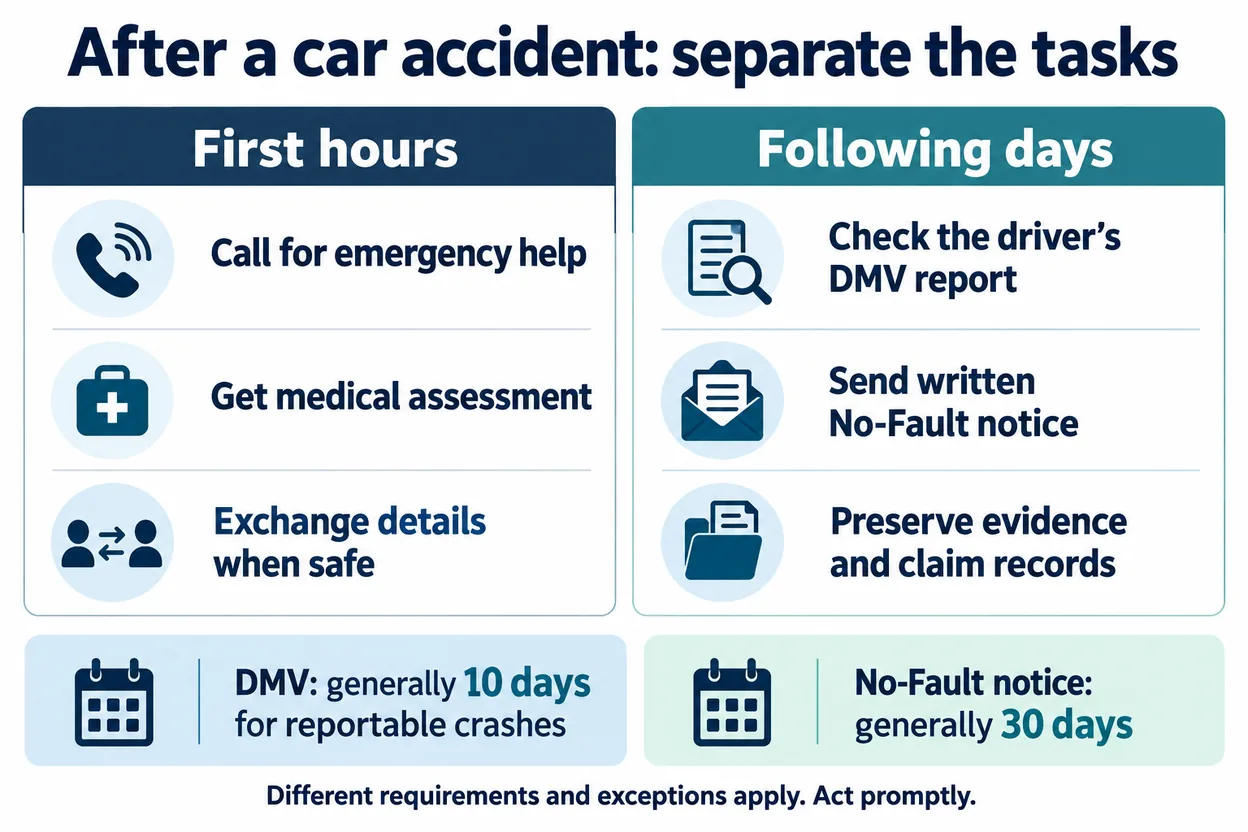
If you are the driver, stop and address the emergency. Call 911 when someone is injured, or ask another person to call. Give the location, describe the injuries and identify hazards such as moving traffic, smoke or an obstructed lane. Follow emergency personnel’s directions about where to wait and whether movement is safe.
Do not step into traffic to take photographs or move an injured person merely to clear the scene. If you are unsure whether movement could worsen an injury, explain the situation to the dispatcher. Your ability to collect information is secondary to getting medical assistance and preventing another collision.
Exchange information without creating another risk
When safe, record the drivers’ names and contact information, vehicle plates and available insurance details. Ask for the police-report reference and retain witness contact information. Photograph identifying documents or vehicle details only with appropriate access and without delaying emergency care.
Describe what you observed instead of arguing about who is legally responsible. You may know that another vehicle moved into your lane without knowing its precise speed or why the driver moved. An uncertain detail should remain uncertain until records or witnesses can clarify it.
What an injured passenger can do
A passenger should report symptoms, seek care and obtain the identity of the vehicle they occupied and its driver. If capable and safe, they can help call for assistance or preserve witness information. They should not assume that another occupant’s insurer contact has opened their own injury claim.
Tell medical providers how the crash occurred, your seating position and the symptoms you experienced. Identify any memory gap or loss of consciousness accurately. Keep discharge instructions and follow the treating team’s recommendations about follow-up and activity restrictions.
The New York DMV accident-report form addresses the driver’s reporting requirements. Those requirements are separate from the passenger’s need to identify the applicable insurer, provide notice and document injuries. If you are hospitalized, ask a trusted person to organize the paperwork while counsel clarifies which tasks can be handled on your behalf.
What evidence and reports should you organize in the following days?
Create a single record of what has been collected, what has been submitted and what is still missing. Keep original photographs and messages, not just a selection of screenshots. Record the exact location and the names of people who may have independent information about the collision.
| Record | Items to keep | What to check |
|---|---|---|
| Collision evidence | Original photographs, video and witness contacts | Whether footage held elsewhere may be overwritten |
| Police information | Report reference and a copy when available | Names, plates and other identifying details |
| Driver’s DMV report | Completed MV-104 and filing evidence | Whether the crash is reportable and the deadline applies |
| Medical information | Treatment records, referrals and work restrictions | Follow-up needs and any missing records |
| Income and expenses | Wage statements, missed-work information and receipts | The period and reason for each claimed loss |
Keep DMV reporting separate from the police response
Under the instructions on Form MV-104, a driver generally must file a report within 10 days for a crash involving injury or death, or property damage exceeding $1,000 to any one person’s property. A police report does not replace that driver requirement. Read the current form instructions and seek help promptly if injury prevents you from completing a required report.
Use accurate information and preserve the submitted version. If a detail is unavailable, obtain guidance rather than inventing a plate number, insurance identifier or collision description. The filing should not become a vehicle for unsupported conclusions about another person’s intentions.
Record the consequences as they develop
Ask treating providers to explain restrictions that affect your work and daily activities. Retain employment records showing missed time and the actual pay consequences. A calendar of missed shifts is more useful when supported by employer or payroll information than when presented as an unexplained total.
Keep receipts for relevant expenses and note why each was incurred. Separate vehicle repair documents from treatment and wage records so the different claims can be reviewed accurately. If a family member helps gather documents, identify the source of each record and avoid editing the original files.
Tell counsel about cameras, towing locations and scheduled repairs before potentially useful evidence changes. You do not need to perform a reconstruction yourself; preserving the available material gives qualified investigators a better starting point.
What should you do about insurance after a car accident in New York?
Identify the insurer and claim type before assuming that a conversation has addressed every issue. First-party No-Fault benefits, vehicle property damage and a bodily-injury liability claim can involve different adjusters, requirements and legal questions. A claim number for car repairs is not proof that an injury benefits application has been submitted.
The New York Department of Financial Services’ No-Fault FAQs explain that an injured vehicle occupant generally applies through the insurer of the vehicle they occupied. Coverage details and exceptions still need review, especially for an uninsured vehicle, a work-related accident or an unusual vehicle or policy arrangement.
Send written notice and keep the record
DFS states that written No-Fault notice should be provided as soon as reasonably practicable and generally no later than 30 days after the accident. Late notice requires clear and reasonable written justification under the applicable rules. Do not assume that the police report, an emergency-room visit or a phone call automatically satisfies this requirement.
Confirm the submission address or method, keep a copy of what you send and retain delivery evidence. Record the claim number, adjuster’s contact information and any further forms requested. Each injured occupant should confirm their own position rather than rely on another person’s claim activity.
Benefits may require additional documentation and compliance with applicable deadlines or examination requests. Open correspondence promptly. If you do not understand a demand or cannot meet a scheduled requirement, obtain advice and communicate through the appropriate process rather than letting the notice go unanswered.
Distinguish benefits from a final injury settlement
No-Fault benefits address specified covered losses under the applicable policy and law. They are not a settlement of every possible damage claim. A liability claim concerns another party’s responsibility and the damages legally recoverable from that party. Property damage concerns the vehicle or other damaged property and should also be tracked separately.
Ask counsel to check the rules applicable to the accident and the actual policies. Keep receipts and payment explanations so that benefits already paid, outstanding expenses and any potential reimbursement issues can be assessed without counting the same loss twice.
Which mistakes can make an injury claim harder to evaluate?
The most avoidable problems are incomplete records, inaccurate assumptions and commitments made before their scope is understood. They can affect the assessment even where an injury is real. A clear factual account and timely response to legitimate requests help prevent unnecessary disputes.
Guessing or reshaping the account
Do not estimate a speed, distance or signal phase as fact when you did not observe it reliably. Separate your memory from information later supplied by another person. If a prior statement contains an error, tell counsel and explain how you discovered it instead of trying to conceal the difference.
Preserve relevant messages, photographs and other existing material. Editing or discarding records can make it harder to establish what happened and may create additional legal issues. Ask the attorney how to handle records that contain unrelated personal information; do not decide on your own to remove potentially relevant content.
Allowing treatment or paperwork gaps to go unexplained
Follow medical recommendations and report changes to the treating provider. If transportation, cost, authorization or scheduling problems interrupt care, keep a factual record and seek help. An unexplained gap can leave others uncertain about whether care was unnecessary, unavailable or simply not documented.
Cooperate with legitimate insurer requirements. A request for necessary claim information should not be treated the same as a broad release of legal rights. Obtain advice about unclear authorizations, recorded statements or proposed settlements promptly enough to address any applicable deadline.
Assuming fault or injury rules guarantee payment
Insurance Law §5104 restricts non-economic recovery in specified motor-vehicle cases through the serious-injury requirement, defined in §5102. Medical evidence and the applicable legal version must be assessed; receiving treatment does not automatically establish every element.
The published CPLR §1411 includes a distinct rule for personal injury actions subject to Insurance Law article 51 that can bar recovery where claimant fault exceeds the defendant’s or combined defendants’ fault. Counsel should verify the amended rule’s applicability to the accident. Older general descriptions of New York comparative fault may therefore be incomplete.
Before signing a release, understand which claims it resolves, what future treatment remains uncertain and how fees, expenses and reimbursement claims affect the amount you receive.
How can Michael Brook help you find a lawyer after a serious car accident?
We can help injured drivers and passengers seek an attorney with experience suited to their car-accident concerns. Michael Brook provides referrals; the referred attorney independently evaluates the case, decides whether to accept representation and handles any accepted legal matter.
For a car accident attorney referral, explain whether you were driving or riding as a passenger, where the collision occurred and what serious injuries you sustained. Mention uncertainty about insurance, an unidentified vehicle, an insurer deadline or a release awaiting signature. These details help describe the legal assistance you need.
Bring the records you already have to the consultation: vehicle and insurer information, the police-report reference, submitted notices, treatment instructions and available photographs. Identify what remains missing rather than delaying the enquiry until the file feels complete.
Ask counsel which insurer should receive notice, whether any reporting task remains outstanding and what evidence needs prompt preservation. Clarify who will handle each step. A referral itself does not file an MV-104, notify an insurer or start a lawsuit.
You can request a free consultation. Before relying on an attorney to manage a deadline, confirm that the engagement has been accepted and understand its scope, fees and expense terms. The initial assessment should explain both the possible claim and the information still needed to evaluate it.
Conclusion: What should be on your post-accident checklist?
Your checklist should distinguish urgent actions from the later decision about settlement. Obtain care, preserve available evidence and check reporting and notice obligations promptly. A final valuation may require more medical and liability information, but that does not suspend the early paperwork requirements.
| Action | Record that confirms completion | Keep separate from |
|---|---|---|
| Emergency care and follow-up | Treatment instructions and appointment records | The later legal assessment of injury damages |
| Required driver reporting | MV-104 copy and filing confirmation | The police report and passenger claims |
| No-Fault notice and application | Written submission, delivery evidence and claim number | A property-damage claim or liability settlement |
| Evidence preservation | Original files, witness contacts and requests handled by counsel | Assumptions about what another party has retained |
| Settlement review | Written terms and an explained net accounting | A preliminary estimate or verbal assurance |
Use the DMV instructions to check the driver’s reporting task and the DFS guidance to address No-Fault notice. Retain correspondence and respond to legitimate requests. Have counsel review unclear releases and the accident-specific injury and fault rules before accepting a final payment.
Sources

Injured in an accident? Michael Brook connects you with top personal injury attorneys who fight to get you the compensation you deserve. Speak with someone today — no cost, no obligation.

After being hit while crossing the street, I had no idea which lawyer to trust. Michael reviewed my situation and connected me with the right attorney immediately.

Michael explained what kind of case I had and referred me to an attorney who handled serious car accidents. That clarity changed everything.

I was injured in a fall and worried it wouldn’t be taken seriously. Michael connected me with an attorney experienced in premises liability cases.

The driver passed away, and I assumed I had no options. Michael explained how insurance works and connected me with an attorney who took action fast.