
Evidence and Investigation After a NYC Truck Accident
A truck collision leaves evidence in several places at once: a witness’s phone, the vehicles themselves, a carrier’s records and your medical file. Each answers a different question, and none of them proves the case on its own.
A truck collision may leave evidence in several places: on a witness’s phone, inside a vehicle, in a carrier’s records and in your medical file. Those records answer different questions. A photograph may show where vehicles stopped, while a dispatch record may help explain the driver’s assignment. Neither automatically proves who caused the crash.
The practical task is to preserve information before it changes and then test how the records fit together. You can protect your own documents while an attorney arranges lawful access to evidence held by other people and businesses.
Which evidence can help explain how a truck accident happened?
Start by separating evidence about the collision from evidence about the injury. Both matter, but a medical diagnosis does not identify which driver had the right of way. Similarly, extensive vehicle damage does not establish the full extent of an individual’s medical condition. A useful investigation connects the accident mechanism, the responsible conduct and the resulting losses without assuming that one record supplies every answer.
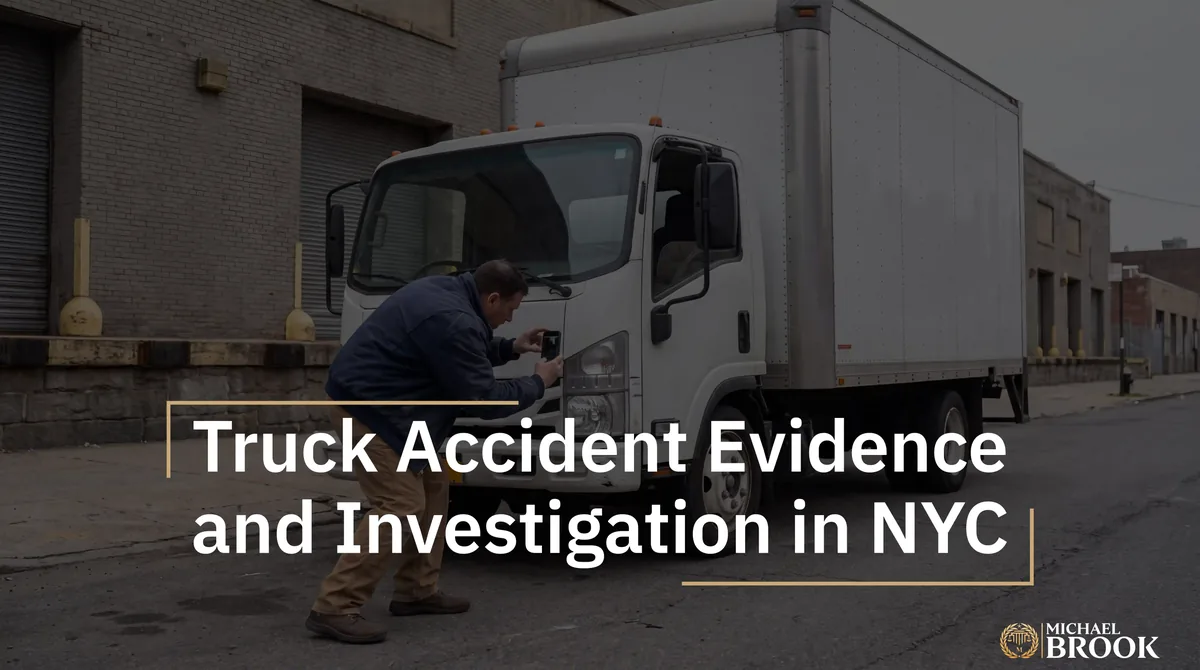
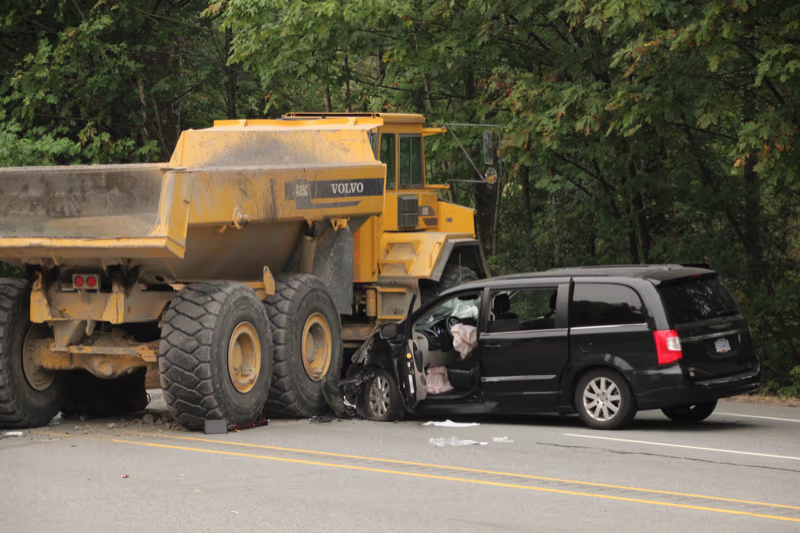
Scene photographs can document lane markings, vehicle positions, road conditions, traffic controls and visible damage. Wider views preserve context; close photographs may show a point of contact or a relevant identifier. Take photographs only when it is safe and lawful to do so. Keep original files because later crops or annotations can omit context.
Identify what each witness actually observed
A person who saw the impact may have useful information about vehicle movement. Someone who arrived afterward may instead describe the positions, lighting or statements made at the scene. Record contact information and distinguish these roles. Do not ask witnesses to adopt your interpretation or fill gaps they did not observe.
Police records may identify drivers, vehicles, witnesses and reported observations. They can provide a starting point, but counsel should distinguish an officer’s direct observations from statements supplied by others. An error in a plate number, diagram or description needs investigation rather than automatic acceptance.
The New York DMV accident-report form also helps identify the types of information to retain. A driver’s reporting obligations are separate from an attorney’s evidence investigation. Keep the report reference and any filing confirmation, and do not assume that a police response completes every driver requirement.
Medical records document symptoms, examination findings, treatment and restrictions. Tell clinicians how the collision occurred and what you experienced, including uncertainty about any loss of consciousness or sequence of events. Preserve appointment information, work restrictions and receipts as the recovery develops. These records help assess causation and loss; they should reflect care and observed limitations, not an attempt to make an accident appear more severe.
What records should be preserved before they are lost?
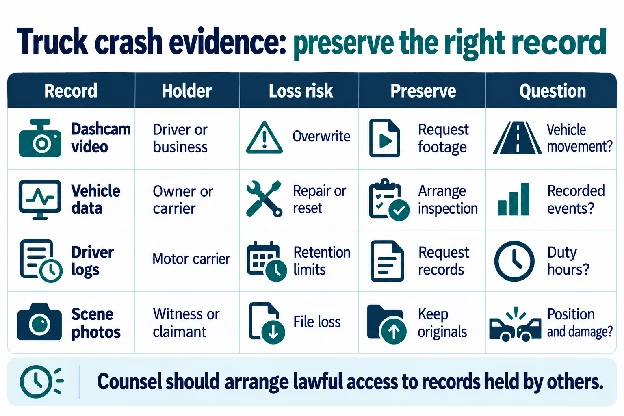
Some truck records change through ordinary business operations. Cameras may overwrite earlier footage, vehicles may be repaired, and devices may be reset or replaced. Early legal review helps identify the relevant holders and the particular information at risk. A broad request for “everything” may miss the name of a subcontractor, a separate trailer owner or a business with a camera facing the intersection.
| Record | Possible holder | Preservation issue |
|---|---|---|
| Dashcam or nearby surveillance | Driver, carrier or nearby business | Footage may be overwritten on a short cycle |
| ECM or other vehicle-event data | Owner, carrier or service provider | Repair, replacement or access methods may affect the data |
| ELD logs and supporting records | Motor carrier and relevant providers | Regulatory retention and litigation preservation are distinct |
| Dispatch and assignment records | Carrier or dispatch business | Messages may be stored across several systems |
| Inspection and maintenance records | Owner, carrier or repair contractor | Identify the vehicle, component and relevant service period |
| Cargo and loading records | Shipper, loader, carrier or warehouse | Documents may identify who loaded, secured or inspected the cargo |
Do not treat every electronic record as a crash recorder
An electronic logging device, or ELD, primarily supports records of driving and duty status. An engine control module, or ECM, serves different functions and may contain particular event data depending on the equipment. A dashcam records images if it was operating and retained the relevant period. The existence of one does not establish that the others exist, or that any device captured the exact moment at issue.
The Federal Motor Carrier Safety Administration’s retention guidance states that carriers must retain records of duty status and supporting documents for six months from receipt under the cited rule. That is not a universal retention period for every truck record, and it is not a safe period to wait before seeking preservation. Litigation-related obligations and a particular system’s overwrite cycle require separate consideration.
Tell counsel about visible cameras, electronic devices, towing arrangements and planned repairs. Keep the truck’s plate, carrier name and other identifiers if they were safely obtained. An attorney can use those details to direct a preservation request to the correct holder and determine whether an inspection or court involvement is needed.
How do attorneys investigate a collision involving a commercial truck?
An investigation usually begins with the account and records already available, followed by a plan for the gaps. Counsel identifies the vehicles, drivers and businesses involved, the likely sources of evidence and the legal questions that evidence must address. A company name on a trailer is a lead; it does not necessarily identify the tractor’s owner, the driver’s employer or the business controlling a particular operation.
Preserve first, then obtain records through the proper route
An attorney may send targeted preservation requests describing relevant vehicles, devices, communications and records. A preservation letter asks the recipient to retain material; it does not guarantee that the material exists, compel immediate production or establish liability. Counsel must consider follow-up measures where information is at imminent risk.
Access may come through consent, an appropriate records request or formal discovery in litigation. The New York courts’ discovery guidance describes procedures for obtaining information relevant to a case, including documents and testimony. Parties may dispute scope, privilege or other objections, which can require court resolution. An injured person should not attempt to access a carrier’s accounts or enter a vehicle without authorization.
Match technical work to a defined question
Vehicle inspections and reconstruction are most useful when they address a specific uncertainty. For example, an investigator may compare impact locations with the claimed direction of travel, or assess whether available measurements support a proposed stopping-distance analysis. The expert must state the assumptions and limits of the available data. A calculation based on an uncertain speed should not be presented as an exact reconstruction.
Evidence handling also matters. Counsel and technical specialists should be able to explain who obtained a file, when it was obtained, whether it is an original or a copy and what was done during extraction or testing. This chain of custody helps others evaluate authenticity and the possibility of alteration.
The process continues as new records arrive. Testimony can identify a previously unknown camera or maintenance contractor, while a document can reveal that an initial timeline was incomplete. A sound investigation revises the factual account when evidence warrants it instead of forcing every record to fit the first explanation.
How can investigators resolve conflicting accounts and missing evidence?
Conflicting statements are common after a sudden collision. People may view the event from different positions, notice different moments or estimate distance inaccurately. Investigators test those differences against independent records rather than assuming that every inconsistency proves dishonesty.
Build a timeline using sources whose timing can be checked. A phone photograph, surveillance system and vehicle device may use different clocks or time zones. Before treating a one-minute discrepancy as decisive, a specialist may need to determine whether the clocks were synchronized and what event each timestamp actually represents. A file’s creation time, for example, may differ from the moment shown in the recording.
Compare physical limits with the account
Sight lines, parked vehicles, lighting and obstructions can help explain what a witness could see. Damage patterns may support or undermine a proposed point of contact, but secondary impacts and post-collision movement must be considered. A final vehicle position is not automatically its position at impact.
Driver logs, dispatch instructions and related communications may help test an account of the driver’s activities. They should be compared with each other and with the applicable rules. An apparent discrepancy may result from incomplete production, a different recordkeeping convention or a substantive problem. The investigation must establish which explanation fits the evidence.
Treat missing material as a question to investigate
Ask whether the record ever existed, who controlled it, when it disappeared and what retention or preservation duties applied. Missing dashcam footage might reflect an inactive camera, routine overwrite or an alleged failure to preserve evidence after a duty arose. Those are different situations. The absence of a file does not, by itself, prove that the driver was negligent or that the file supported your account.
Formal discovery procedures can help establish what was requested and produced and provide a route for resolving disputes. Any request for a legal remedy based on lost evidence depends on the governing standards and the facts, not simply on disappointment that a useful record is unavailable.
Ask counsel to distinguish established facts, reasonable inferences and unresolved questions. That separation helps you understand both the strength of the case and what further investigation can realistically accomplish.
How can Michael Brook help you find an attorney to investigate a serious truck crash?
If a truck crash has caused a serious injury, we can help you seek an attorney with experience relevant to commercial-vehicle cases. Michael Brook provides referrals. The referred attorney independently evaluates the information, decides whether to accept the matter and handles the legal work for any accepted case.
When requesting a truck accident attorney referral, describe the crash location, your injuries and the vehicles or companies you can identify. Mention evidence that may be time-sensitive, such as a visible dashcam, a nearby business camera or a vehicle awaiting repair. You do not need to obtain the carrier’s internal records before making an enquiry.
For the legal consultation, gather the police-report reference, available photographs, witness contacts, insurer correspondence and initial treatment records. Identify what you have personally seen and what someone else told you. This helps the attorney assess the investigation needed without mistaking an assumption for a verified fact.
Ask who would handle preservation requests, whether technical expertise may be needed and which steps require an accepted engagement. A referral does not mean that a letter has been sent, a lawsuit has been filed or a deadline has been extended.
You can request a free consultation to discuss finding suitable counsel. The attorney’s independent assessment should explain the evidence gaps as well as the potentially useful records.
Conclusion: Which truck accident records need the earliest attention?
Give early attention to material that can change through overwrite, repair or ordinary operations. Preserve your own originals, identify other evidence holders and let counsel arrange lawful requests and inspections. Continue documenting treatment and losses while the collision investigation proceeds.
| Priority | Practical action | Why it matters |
|---|---|---|
| Video and electronic records | Identify cameras, devices and holders promptly | Retention periods differ and data may be overwritten |
| Vehicles and components | Tell counsel where they are and whether repairs are planned | An inspection may need to precede physical changes |
| Witness and scene information | Keep original files and reliable contact details | Later accounts need context and a traceable source |
| Medical and work evidence | Retain treatment records, restrictions and wage documentation | The injury and financial effects need their own proof |
Use the FMCSA retention guidance as a reason to distinguish record types, not as a reason to delay. Keep driver-reporting questions separate from the lawsuit investigation. Where a holder will not provide information, ask counsel about the appropriate discovery procedure rather than trying to obtain access yourself.
The strongest account is one that explains what the records establish, how they were obtained and where uncertainty remains. No single photograph, log or report substitutes for that assessment.
Sources

Injured in an accident? Michael Brook connects you with top personal injury attorneys who fight to get you the compensation you deserve. Speak with someone today — no cost, no obligation.

After being hit while crossing the street, I had no idea which lawyer to trust. Michael reviewed my situation and connected me with the right attorney immediately.

Michael explained what kind of case I had and referred me to an attorney who handled serious car accidents. That clarity changed everything.

I was injured in a fall and worried it wouldn’t be taken seriously. Michael connected me with an attorney experienced in premises liability cases.

The driver passed away, and I assumed I had no options. Michael explained how insurance works and connected me with an attorney who took action fast.