
Steps to Take After a Construction Accident at Work in NYC
A construction injury leaves you dealing with treatment, missed pay and questions from several companies at once. Telling a supervisor does not by itself file a workers’ compensation claim, and a benefits claim does not settle whether another company is responsible.

A construction injury can leave you dealing with treatment, missed pay and questions from several companies at once. Start with medical care, then create a reliable record of what happened. Reporting the incident to a supervisor does not necessarily file your workers’ compensation claim, and a benefits claim does not resolve whether another party caused the accident.
The steps below help you organize those separate tasks without returning to an unsafe site or trying to investigate while injured.
What should you do first if you are injured on a construction site?
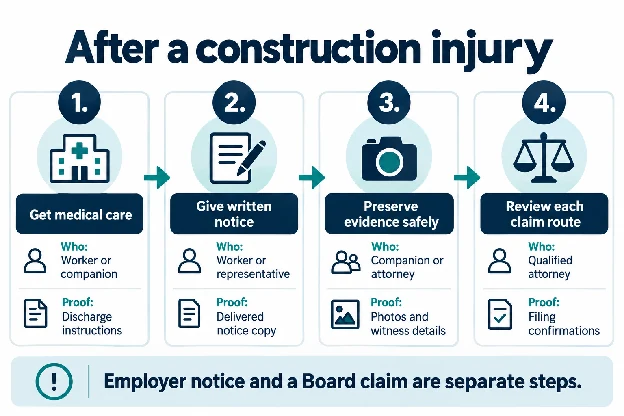
Get emergency assistance when the injury or conditions require it. Call 911, or ask someone nearby to call and identify the precise site entrance and location within the building. Tell responders about an ongoing hazard, such as unstable material, exposed wiring or a suspended load. Do not re-enter a dangerous area to retrieve tools, take photographs or finish a task.
If you can move safely, follow emergency personnel’s directions. If movement could worsen the injury, explain that concern to the dispatcher and wait for help. A coworker can direct responders to you and notify the supervisor while you focus on treatment. An injured person should not have to choose between receiving care and obtaining an incident-report number.
Make the work connection clear to the treating team
Tell the clinician that the injury happened at work and describe the mechanism in ordinary terms: a platform shifted, material struck you, or your hand became trapped. Identify symptoms and the parts of your body affected without trying to diagnose yourself. If you were briefly unconscious or cannot remember the sequence, say so instead of filling the gap with a guess.
The New York Workers’ Compensation Board’s injured-worker guidance explains that emergency treatment can come first; outside an emergency, treatment generally must be provided by a Board-authorized provider. Ask the treating office how your work injury is being recorded and how follow-up care will be arranged.
Before leaving, keep the discharge instructions, medication information, referrals and any work restrictions. Ask whom to contact if symptoms change or you cannot obtain the recommended appointment. Follow medical advice about returning to work, driving and lifting rather than relying on a supervisor’s assessment of what you can manage.
If hospitalization prevents you from handling paperwork, ask a trusted person to keep one folder containing these records and the names of people who contact you. That person can help organize information; an attorney should clarify any authority needed to act formally on your behalf.
How should you report the accident and start a workers’ compensation claim?
Treat employer notice and filing with the Workers’ Compensation Board as two different tasks. Telling a foreman about an injury may start the company’s internal reporting process, but it does not establish that your employee claim reached the Board. Likewise, an employer’s incident report should not be assumed to contain a complete or accurate account of your symptoms.
For an ordinary accidental work injury, the Board advises written notice to the employer within 30 days and filing an employee claim, generally within two years of the accident. Exceptions and different rules may apply to particular circumstances, so address a missed or uncertain deadline promptly instead of deciding that there is no claim.
| Task | What to include | What to retain |
|---|---|---|
| Notify the employer in writing | Your identity, accident date and location, and how you were injured | The notice and evidence of delivery |
| File the employee claim with the Board | Accurate employment, accident, injury and treatment information on Form C-3 | Submission confirmation and a complete copy |
| Check subsequent correspondence | Claim number, requests for information and any hearing or examination notices | Dated correspondence and your responses |
Build a record that you can verify
Use a reporting method that leaves a record and keep a copy outside any work account you might lose access to. If the company provides a form, read it before signing. Correct an inaccurate location, mechanism or description of your duties, and identify facts you do not yet know. Do not sign a blank form or confirm that you are uninjured simply because a supervisor expects a quick return to work.
The Board’s injured-worker toolkit provides the employee filing route and explains the next steps. Answer the C-3 accurately; a lawyer can help where the employer’s identity, employment status or accident history is disputed. Keep track of which company paid you and which company directed the work, because they may not be the same entity.
After filing, open notices and respond to legitimate requests within the stated time. A claim number shows that a file exists; it is not a promise that every requested benefit has been accepted. Keep records of wage loss, treatment and any dispute so counsel can address the actual issue.
What evidence can you preserve without putting yourself at risk?
Preserve what is lawfully available from a safe place. The goal is to retain a reliable account of the scene before equipment moves, witnesses leave or a work area changes. Medical care remains the first priority, and you should not cross barriers, climb damaged equipment or confront someone who controls a restricted site.
If possible, ask a companion or coworker to record the following:
- Exact location: the address, floor, stairwell, unit, work zone or nearest fixed landmark.
- Equipment identity: a machine’s make, visible serial number, rental-company label or platform identifier.
- Companies involved: the employer, general contractor and other businesses whose names appear on visible signs or equipment.
- Witness information: names, contact details and what each person actually saw or heard.
- Scene conditions: wider photographs showing the work area and closer views of the relevant hazard, taken without disturbing it.
- Incident details: the person who prepared the report, when it was made and how to request a copy.
Keep originals and distinguish observation from inference
Save original photographs and videos rather than only cropped screenshots or edited copies. Preserve related text messages, work instructions and shift information. A photograph showing a ladder after a fall does not by itself establish how the ladder was positioned beforehand; a witness who saw it move may supply a different part of the account.
Write a short factual timeline while your memory is fresh. Separate what you observed from what another person later told you. If you do not know who installed a platform or inspected a machine, record that as an unanswered question. Guessing a company’s role can send an investigation in the wrong direction.
When you cannot collect anything yourself
Hospitalization does not mean that all evidence is lost. Tell an attorney where the incident occurred, who was present and what records may exist. Site surveillance, inspection logs, contracts and equipment records may require requests to their holders and, where appropriate, formal legal procedures. Your family can preserve your own messages and photographs, but should not obtain access to another person’s account or remove equipment from the site.
Keep the evidence folder separate from your treatment diary. Both can help, but the first concerns the accident and the second records how the injury affects you over time.
Which early decisions can affect your benefits or a third-party claim?
Follow recommended treatment and keep your providers informed about changes in symptoms and work demands. If you miss an appointment because of transportation, an authorization dispute or another practical barrier, record the reason and seek help resolving it. An unexplained gap may leave both your clinician and a claim reviewer with an incomplete picture of your recovery.
Give accurate accounts to medical providers, the Board and counsel. Differences that reflect new information should be explained, not concealed. For example, learning the correct name of a contractor is different from changing your description of how a fall occurred. Keep copies of prior statements so an attorney can identify and clarify any genuine mistake.
Review documents before releasing rights
A routine request for claim information is different from a broad settlement release or an authorization for extensive unrelated records. Understand what a document covers before signing it. Do not ignore legitimate benefit-process requirements; ask counsel to distinguish necessary cooperation from a request that reaches beyond the claim.
Under Workers’ Compensation Law §29, a claim against a responsible third party may coexist with workers’ compensation, but the recoveries require coordination. A third-party settlement can raise reimbursement, future-benefit and consent or court-approval questions. The amount offered is therefore not the only issue to review before accepting a settlement.
Possible third-party responsibility might involve an owner, a contractor outside your employment or a defective product. Naming a business on a site sign does not establish its legal liability. An attorney must determine its duties, its relationship to your employer and how its conduct relates to the injury.
Identify public-entity issues early
Tell counsel if the site, vehicle or equipment may be connected to a city agency or another public entity. Where General Municipal Law §50-e applies, a notice of claim is ordinarily required within 90 days after the claim arises. That is separate from workers’ compensation notice and filing requirements. The correct entity, service method and applicable exceptions require review; sending an incident report to a site manager may not satisfy them.
Ask for a written explanation of which immediate steps counsel will handle and which remain your responsibility. Contacting a referral service alone does not file a claim or preserve a deadline.
How can Michael Brook connect you with a lawyer after a serious jobsite accident?
If you have a serious construction injury, we can help you seek an attorney whose experience is relevant to the accident and the possible claims. Michael Brook provides an attorney referral service. The referred attorney independently evaluates your circumstances and decides whether to accept the matter; any accepted legal work is handled by that attorney.
When requesting a construction accident attorney referral, explain the main facts without delaying contact to assemble a perfect file. Useful information includes the accident location and timing, your employer’s name, the type of work you were doing, your main injuries and whether another company or public entity may be involved.
Let us know if you are hospitalized, have received a legal notice or believe surveillance may be overwritten. These facts help describe the kind of legal assistance you are seeking. They do not establish that a particular lawyer has agreed to represent you or that a filing has already been made.
For the attorney’s assessment, bring any employer notice, C-3 confirmation, incident report, available photographs and treatment instructions. Ask whether the review will address both workers’ compensation and potential third-party responsibility, and whether separate counsel may be needed to coordinate those matters.
You can request a free consultation. Before relying on an attorney to take a time-sensitive step, confirm that the engagement has been accepted and clarify its scope in writing.
Conclusion: Which actions protect your options after a construction injury?
The most useful response is a sequence of completed, documented tasks. Get care first, give timely written notice, confirm the employee filing and preserve the information that remains available. Then have the possible claim routes reviewed together so that a decision in one matter does not create an avoidable problem in another.
| Priority | Completion record | Question to resolve |
|---|---|---|
| Treatment and follow-up | Discharge instructions, appointments and work restrictions | What care or assistance is needed next? |
| Employer notice and Board filing | Delivered notice and C-3 confirmation | Have both separate steps been completed? |
| Accident evidence | Original files, witness contacts and incident-report details | What could change or disappear soon? |
| Legal review | Accepted engagement and assigned responsibilities | Are third-party, public-entity and settlement issues covered? |
Use the Board’s guidance to check your reporting and filing steps, and obtain legal advice promptly about uncertain deadlines. Preserve evidence safely rather than trying to reconstruct the entire accident yourself. Before signing a third-party settlement, ask counsel to explain the workers’ compensation consequences and the expected net recovery.
Completing this checklist does not guarantee claim acceptance. It gives the people assessing your benefits, treatment and legal options a clearer record on which to act.
Sources

Injured in an accident? Michael Brook connects you with top personal injury attorneys who fight to get you the compensation you deserve. Speak with someone today — no cost, no obligation.

After being hit while crossing the street, I had no idea which lawyer to trust. Michael reviewed my situation and connected me with the right attorney immediately.

Michael explained what kind of case I had and referred me to an attorney who handled serious car accidents. That clarity changed everything.

I was injured in a fall and worried it wouldn’t be taken seriously. Michael connected me with an attorney experienced in premises liability cases.

The driver passed away, and I assumed I had no options. Michael explained how insurance works and connected me with an attorney who took action fast.