
Steps to Take After Being Hit by a Car in NYC
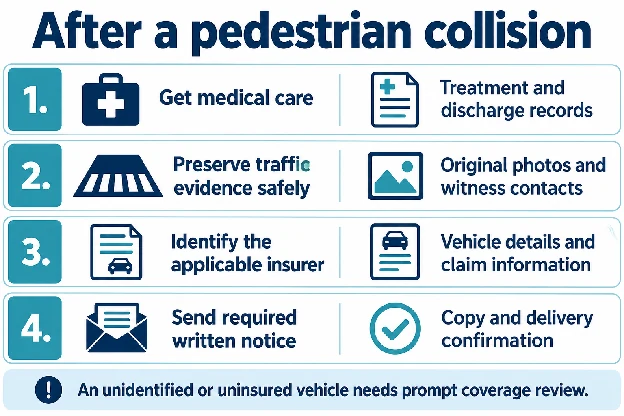
After a pedestrian collision the first priorities are medical care and safety. The legal and insurance steps come next, and some of them are time-sensitive: a police response, a hospital record and an insurance claim each serve a different purpose.
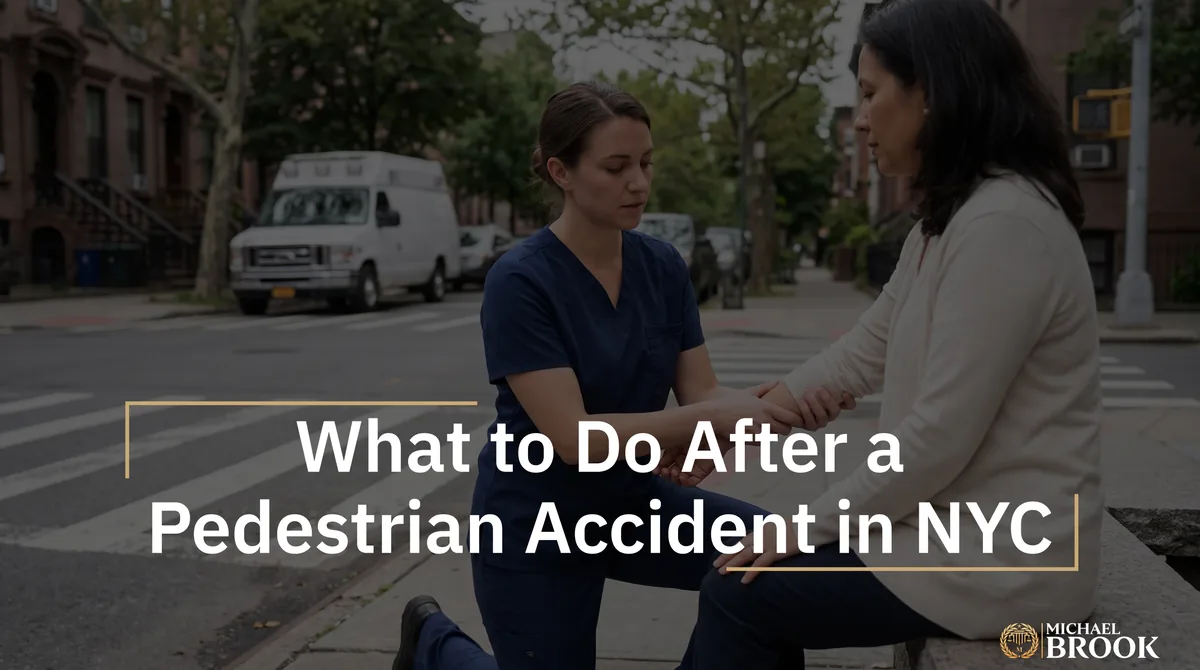
After a pedestrian collision, your immediate priorities are medical care and protection from further danger. The legal and insurance questions come next, but some of those steps are time-sensitive. A police response, a hospital record and an insurance claim each serve a different purpose.
Organizing these tasks helps you avoid two common gaps: losing information about how the collision occurred and assuming that someone else has sent the required insurance notice. If you are hospitalized, a trusted person can help collect records while an attorney reviews the applicable claims and deadlines.
What should you do immediately after being hit by a car?
Call 911 or ask someone nearby to call. Give the intersection or address, describe the injuries and identify any ongoing traffic danger. Follow the dispatcher’s and emergency personnel’s instructions. Do not try to walk away simply to avoid delaying traffic, and do not move into an unsafe position to obtain a photograph or speak to the driver.
If you can reach a safe place without worsening an injury, do so as emergency personnel advise. Otherwise, tell the dispatcher where you are and whether traffic is still moving nearby. A companion can alert responders and provide location details while you concentrate on receiving help.
Let someone else record details when necessary
When safe, obtain the vehicle’s plate, driver’s name and contact details, and available insurance information. A photograph of the vehicle and identifying information can help avoid transcription errors. If the driver leaves, note only what you actually remember, such as the direction of travel, vehicle color or a partial plate. Do not pursue the vehicle or turn an uncertain observation into a definite identification.
Ask a companion to retain witness contacts and the responding officers’ report reference. The New York DMV accident-report form illustrates the identifying information used in collision reporting, but the driver’s filing obligations should not be confused with a pedestrian’s own insurance and legal steps.
Give clinicians a clear account
Seek prompt medical assessment and describe being struck as a pedestrian. Explain where the vehicle contacted you, whether you fell and what symptoms you noticed. If you cannot remember part of the event, say so. Follow the treating team’s advice about testing, follow-up and activity restrictions; do not use the apparent severity of vehicle damage to judge your medical needs.
Keep discharge instructions, referrals, prescriptions and appointment details. If symptoms change or you have difficulty arranging recommended care, contact the treating provider. Ask a trusted person to keep these records together if pain, hospitalization or other limitations make paperwork difficult. Receiving care should not depend on your ability to reconstruct the collision at the scene.
Which details can help show how the pedestrian collision occurred?
The most useful records explain where the pedestrian and vehicle were, how they moved and what each person could see. A photograph of a crosswalk is helpful only if the location and its relationship to the impact are clear. Likewise, saying “the light was green” may leave unanswered which signal the witness observed and at what moment.
| Detail | What to record | Question it may help answer |
|---|---|---|
| Crossing location | Intersection, crosswalk position and direction of travel | Where was the pedestrian before contact? |
| Signal phase | The specific pedestrian or vehicle signal observed | What indication applied to the movement? |
| Vehicle movement | Turning direction, lane and visible approach | How did the paths intersect? |
| Visibility | Lighting, weather, parked vehicles and obstructions | What could the participants reasonably see? |
| Witnesses and cameras | Contact details and camera location | Is there an independent account or recording? |
Preserve context, not just a close-up
If photographs can be taken safely, retain both wider scene views and closer images of relevant markings or damage. Original files are preferable to screenshots sent through several messaging services. Do not change the scene, step into traffic or return to an unsafe location to recreate a photograph.
Write a factual account while the sequence remains fresh. Include what you remember about your direction of travel, where you first noticed the vehicle and what happened after impact. Separate personal observations from information later supplied by a witness or family member. If your recollection changes because a record refreshes it, explain the source of the additional detail.
Use reports and crosswalk information carefully
A police report can identify participants and record observations, but it may also contain statements from people who did not see the same parts of the event. Review obvious identifying errors with counsel and preserve the original version. The report should be evaluated alongside the other evidence.
Being within a crosswalk can be relevant to the legal assessment, but it does not by itself resolve every question of conduct or causation. Counsel may need to examine the applicable traffic controls, movements and available testimony. Nearby surveillance is especially time-sensitive because the holder may routinely overwrite it; identify the location promptly so an attorney can consider a lawful preservation request.
How do you notify the appropriate insurer after a pedestrian accident?
For a pedestrian struck by an insured motor vehicle, the usual No-Fault route is through the insurer of the vehicle that struck them. No-Fault benefits and a liability claim are different matters. Applying for benefits does not require you to resolve every dispute about who caused the collision, and it does not settle a claim for all injury-related damages.
The New York Department of Financial Services’ No-Fault guidance calls for written notice as soon as reasonably practicable and generally within 30 days after the accident. A late notice requires clear and reasonable written justification under the applicable rules. Do not assume that hospitalization automatically excuses every delay, or that a phone call alone satisfies a written-notice requirement.
Confirm the insurer and retain proof
Use the vehicle details, police information and available insurance records to identify the appropriate insurer. Ask how to submit notice, which claim number to use and where supporting forms should go. Keep copies of the notice, delivery confirmation, completed applications and subsequent correspondence. A medical provider’s billing activity is not a reliable substitute for checking your own notice and application obligations.
Track requests for information, examination notices and other claim requirements. If a request is unclear, obtain advice promptly; ignoring it can create a separate benefits dispute. Keep treatment bills and receipts organized even if the insurer or provider has another copy.
Missing or unusual coverage needs separate review
A hit-and-run collision or an apparently uninsured vehicle requires prompt assessment of alternative coverage and eligibility. DFS explains that household coverage and the Motor Vehicle Accident Indemnification Corporation may be relevant in appropriate circumstances. Their requirements should be checked rather than assuming that an unidentified driver means there is no possible route to benefits.
If you were working when struck, tell counsel and the insurers. Workers’ compensation and No-Fault coordination may affect which payer is responsible. The same care should be taken with uncertain vehicle classifications or out-of-state policies.
Do not wait for the entire liability investigation before addressing these questions. The immediate objective is to identify the correct notice route and comply with its requirements while the facts and medical picture continue to develop.
What should you consider before giving statements or accepting payment?
Give truthful information and identify what you do not know. You can describe where you were walking and what you saw without estimating a vehicle’s exact speed or accepting a legal conclusion about fault. If pain, medication or incomplete memory affects your ability to give an accurate account, explain that limitation and obtain advice about the requested statement.
Necessary cooperation with an applicable insurer is different from signing a broad settlement release. Some claims involve legitimate requirements to provide information or attend an examination. Ask counsel to clarify an uncertain request promptly rather than adopting a blanket refusal to communicate.
Understand what the proposed payment resolves
A payment may concern a specific benefit, expense or broader injury settlement. Read the accompanying documents and ask whether accepting it releases claims against a driver, owner, insurer or another party. A quick payment can be difficult to assess while treatment needs and work restrictions remain unclear.
Continue recommended care and keep an accurate record of limitations. If treatment is interrupted by access, transportation or coverage problems, document the reason and seek help resolving it. A factual record is more useful than an exaggerated symptom diary or an unexplained gap in care.
Check the applicable injury and fault rules
In covered motor-vehicle cases, Insurance Law §5104 limits recovery for non-economic loss through the serious-injury requirement, with definitions in §5102. Counsel must connect the medical evidence to the applicable legal standard; the fact that a pedestrian was struck does not automatically satisfy it.
The published CPLR §1411 also includes a separate fault rule for personal injury actions subject to Insurance Law article 51, potentially barring recovery when the claimant’s fault exceeds that of the defendant or combined defendants. An attorney should check the amended provisions’ applicability to the accident. Avoid relying on an older general statement that any share of fault merely reduces damages.
Before accepting a settlement, ask for the supported damages, legal constraints, available coverage and proposed deductions to be explained separately. The gross offer and the amount you ultimately receive are not necessarily the same.
How can Michael Brook help an injured pedestrian find a suitable attorney?
We help people seek counsel for serious pedestrian injuries, including matters with disputed collision facts or uncertain insurance information. Michael Brook provides referrals. The referred attorney independently assesses the circumstances, decides whether to accept representation and handles the legal work for any accepted matter.
When requesting a pedestrian accident attorney referral, describe the location, your main injuries and whether the driver and vehicle have been identified. Mention any approaching notice issue, insurer correspondence or known camera location. These facts help explain the experience your enquiry calls for.
For the consultation, gather the records already available: treatment instructions, photographs, witness contacts, the police-report reference and any insurer information. Mark uncertain details clearly. If you cannot manage these tasks because of your injuries, a trusted person can help organize the material and explain what remains missing.
Ask the attorney which insurance notice route applies, how traffic evidence can be preserved and what additional medical information is needed to assess the claim. Confirm who will take each immediate step and whether representation has been accepted. Contacting a referral service does not itself send an insurance notice or file a lawsuit.
You can request a free consultation before every record is available. The purpose is to seek suitable legal help while the relevant deadlines and evidence can still be addressed.
Conclusion: What should an injured pedestrian organize before a case review?
Bring a clear record of care, the collision and insurance communications. Missing information should become a specific question for counsel, especially when the driver is unidentified or the vehicle may be uninsured. Do not postpone necessary notices while trying to complete the entire investigation.
| Record group | Items to organize | Question for the case review |
|---|---|---|
| Medical | Discharge records, follow-up appointments and restrictions | What treatment and functional effects are documented? |
| Collision | Original photographs, location, witnesses and report reference | What evidence explains the movements and signals? |
| Insurance | Vehicle details, insurer letters and claim numbers | Which coverage and notice requirements apply? |
| Submitted paperwork | Notice copies, applications and delivery confirmations | What has actually been completed, and what remains due? |
Follow medical advice, preserve original evidence safely and use the DFS guidance to address written notice promptly. Have counsel check the accident-specific application of the injury and fault rules before relying on a settlement estimate. A complete folder cannot guarantee an outcome, but it can prevent avoidable uncertainty about which facts and tasks still need attention.
Sources

Injured in an accident? Michael Brook connects you with top personal injury attorneys who fight to get you the compensation you deserve. Speak with someone today — no cost, no obligation.

After being hit while crossing the street, I had no idea which lawyer to trust. Michael reviewed my situation and connected me with the right attorney immediately.

Michael explained what kind of case I had and referred me to an attorney who handled serious car accidents. That clarity changed everything.

I was injured in a fall and worried it wouldn’t be taken seriously. Michael connected me with an attorney experienced in premises liability cases.

The driver passed away, and I assumed I had no options. Michael explained how insurance works and connected me with an attorney who took action fast.