

Records, Expert Opinions and Causation in New York Medical Malpractice Claims
An unexpected complication, a second operation or a later diagnosis can raise questions about medical care, but none of them proves malpractice on its own. An evaluation must identify what accepted care required, how the provider allegedly departed from it and whether that caused additional injury.
An unexpected complication, a second operation or a later diagnosis can raise serious questions about medical care. Those events do not, by themselves, establish malpractice. A legal evaluation needs to identify what accepted care required, how the provider allegedly departed from it and whether that departure caused additional injury.
Your most useful contribution is an accurate account supported by records. You do not need to diagnose negligence yourself. Preserve the information available to you, continue medically appropriate care and seek a prompt assessment from a qualified attorney before assuming that a filing period runs from the day you discovered the problem.
What separates medical malpractice from an unsuccessful treatment outcome?
Medical treatment can carry risks even when a professional follows accepted practice. A procedure may fail to relieve symptoms, a disease may progress despite treatment or a recognized complication may occur without negligence. A malpractice inquiry examines the care provided in the circumstances, rather than reasoning backward from the result alone.
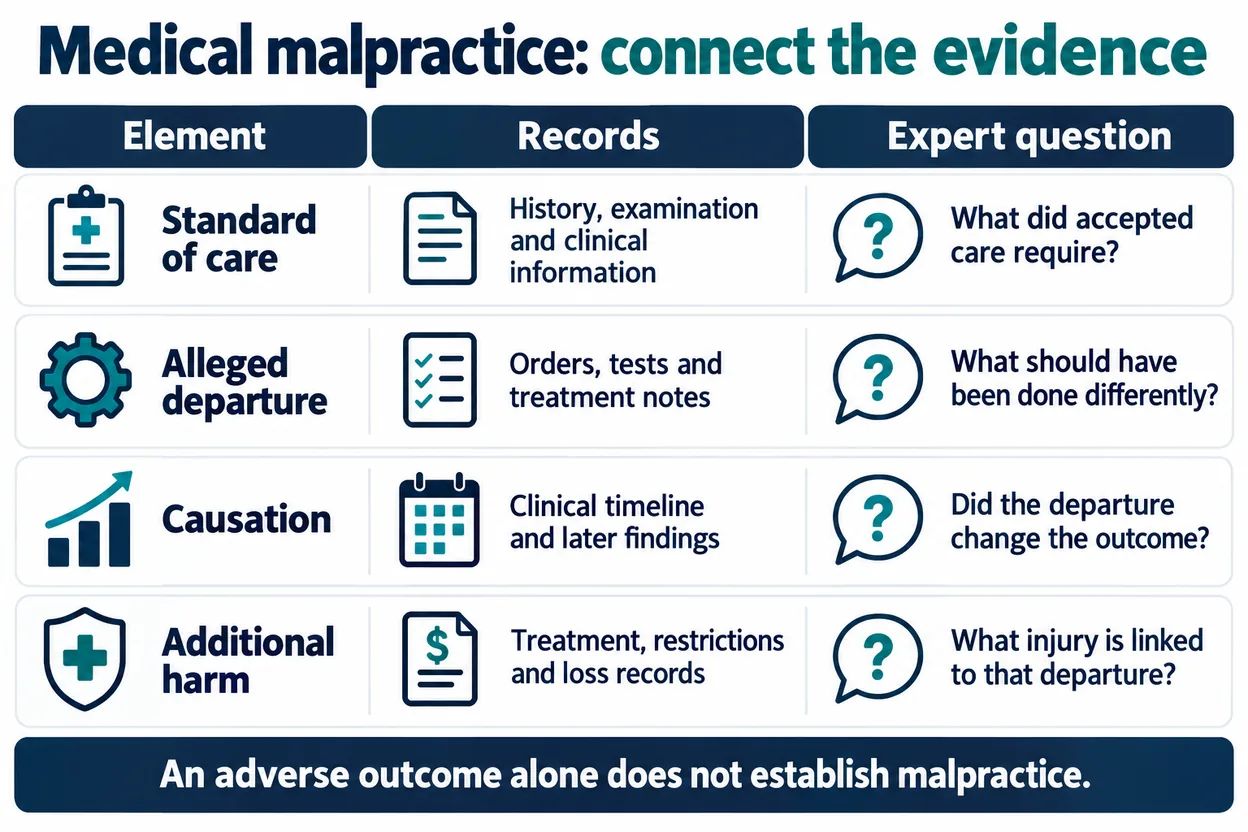
The New York City Bar’s explanation of medical malpractice describes the need to connect care that falls below the applicable standard with the patient’s injury. The key questions concern the provider’s professional obligations, the alleged departure, the causal connection and the resulting harm. They usually require careful medical and legal assessment.
Identify the specific decision or omission
“The treatment did not work” describes a result. “The record shows a concerning test result, but I cannot find evidence that anyone reviewed or communicated it” identifies a question that can be investigated. The second statement still does not prove negligence: the complete record may show a review elsewhere, a reasonable explanation or a different responsible provider. It gives counsel a concrete starting point.
A known complication does not automatically rule a claim in or out. The review may need to address whether the complication could occur despite proper treatment, whether preventive steps were required and whether the response met accepted practice once it arose. Likewise, a signed consent form does not answer every question about how care was actually delivered.
Keep the injury question separate
An avoidable documentation error that did not affect care presents a different issue from a failure that led to additional treatment or lasting impairment. A disappointing result can be serious and distressing without being legally attributable to malpractice. Conversely, a medically plausible allegation must still be connected to compensable harm.
For an initial review, describe the treatment, the event that raised concern and the later harm in separate sentences. That helps distinguish what happened from why you believe it happened. Mark uncertainties openly and let the attorney and appropriately qualified clinicians assess the missing connections.
Which medical records help reconstruct what happened?
Build a chronology that allows someone unfamiliar with your care to follow it. Start with the relevant symptoms and treatment history, identify each provider and list the major examinations, tests, procedures and follow-up contacts. Use exact dates from documents where available. If a date or conversation comes only from memory, label it accordingly.
An electronic portal may contain useful information without including the complete chart. For example, a patient-facing visit summary may omit medication-administration details, nursing observations or the underlying images. Give counsel the records you already have and identify facilities from which additional materials may need to be obtained through appropriate authorizations or legal procedures.
| Record type | What it can help establish | Question to flag for review |
|---|---|---|
| Office, emergency and inpatient notes | Reported symptoms, findings and the treatment plan | What information was documented at each encounter? |
| Orders and test results | What was requested and when results became available | Who was expected to review or act on the result? |
| Diagnostic images and reports | The recorded interpretation and underlying study | Does the expert need the images as well as the report? |
| Medication and procedure records | Treatment given, timing and recorded observations | Is there a difference between an order and what was administered? |
| Discharge instructions and referrals | The follow-up plan and warnings provided | Was further assessment arranged or communicated? |
| Messages and telephone records | Reported changes and the response received | What did each participant know at that time? |
Preserve facts without changing the originals
Keep original downloads, correspondence and photographs in their original form. Make your chronology separately; do not write corrections into source records or remove an entry because you disagree with it. If a record appears inaccurate, explain the issue to counsel and keep any formal amendment request and response with the file.
Include relevant earlier care, even if you think it may complicate the claim. A prior diagnosis, similar symptom or earlier procedure can help the reviewer distinguish the underlying condition from additional harm. Leaving it out can create an incomplete medical picture.
Document the practical losses as well: additional appointments, prescribed restrictions, work absence and assistance you needed. State who observed a limitation and what it prevented you from doing. A dated description of an actual task you could no longer perform is more useful than a general statement that every part of life changed. Continue to report health concerns to treating clinicians; a legal chronology is not a substitute for a medical assessment.
How do medical experts assess a departure from accepted practice?
The expert’s knowledge needs to fit the question being examined. An allegation about interpreting an image, managing postoperative symptoms or selecting a treatment may require different expertise. The important issue is whether the professional can address the particular standard and clinical circumstances, rather than whether they hold an impressive title unrelated to the disputed care.
CPLR §3012-a reflects that focus in the attorney’s certificate requirement for covered malpractice actions. The usual certification involves counsel’s factual review and consultation with a licensed professional reasonably believed knowledgeable about the relevant issues. It records counsel’s conclusion that a reasonable basis exists to commence the action; it is not a judicial finding that malpractice occurred.
Reconstruct the information available at the time
A sound review asks what the clinician knew or reasonably should have considered when making the disputed decision. Later findings may help explain an earlier event, but they should not simply be treated as though they were already known. The review may need to examine the reported symptoms, examination, available test results, urgency, treatment options and follow-up arrangements.
For a hypothetical example, consider a patient who develops a complication after discharge. The relevant questions may include which symptoms were present before discharge, what monitoring or instructions were appropriate and what response was required when new symptoms were reported. The mere fact that the patient was later readmitted does not answer those questions.
Understand why opinions may differ
Experts can disagree about what the records show, which practices were acceptable or whether a different response would have mattered. Ask counsel to explain the factual basis for a favorable opinion and the strongest contrary explanation. An opinion that assumes an undocumented symptom or ignores a significant test result may need further scrutiny.
Keep these questions available for the consultation:
- What precise act or omission is under review?
- Which professional standard does the expert say applied?
- Which records support that assessment, and which are missing?
- What alternative interpretation is the defense likely to offer?
The objective is an opinion that addresses the actual record. A confident conclusion cannot repair a missing factual premise, and an identified departure still requires a separate analysis of whether it caused injury.
How can you link the alleged error to additional harm?
Causation asks whether the alleged departure made a legally significant difference to the patient’s outcome. The comparison is between the actual course and the medically supported course expected with appropriate care. It is not a comparison between the actual outcome and an assumption of perfect health.
In Berger v Shen, the appellate court distinguished an established departure from proof that it caused the injuries. The court found the causal evidence insufficient: the asserted postoperative failures were not adequately connected to the harm, and the missing connection could not rest on speculation. The decision shows why a malpractice evaluation must address both questions independently.
Separate the disease from the additional injury
An underlying condition may already have required surgery, medication or time away from work. The reviewer must consider whether an alleged error added to those burdens, changed their timing or worsened the prognosis. Relevant comparisons may involve additional procedures, a longer recovery, lost treatment options or a new impairment, but those consequences need medical support.
A practical way to prepare is to organize three sets of facts:
- Before the disputed care: diagnosis, symptoms, function and the treatment already expected.
- During the disputed period: the alleged missed opportunity or harmful intervention and the evidence showing when it occurred.
- Afterward: subsequent findings, treatment, restrictions and the clinician’s explanation of their cause.
This organization helps counsel frame expert questions without asking you to supply a medical conclusion. If a later doctor explains that a particular event may have affected recovery, preserve the record of that explanation and distinguish it from your own recollection of an informal conversation.
Address competing explanations directly
An expert may need to account for the severity of the original disease, unavoidable complications, unrelated conditions and the patient’s response to treatment. A claim should not attribute every later symptom to one disputed event merely because it occurred earlier. Equally, the presence of a pre-existing condition does not by itself establish that the alleged departure caused no additional harm.
Ask which consequences the expert can connect to the departure, which remain uncertain and what additional evidence could resolve the uncertainty. That answer informs both whether the claim has support and which losses can responsibly be included. It also helps avoid presenting an extensive list of expenses that cannot be tied to the alleged malpractice.
How can Michael Brook help you find a lawyer to evaluate suspected medical malpractice?
If you experienced serious harm and have questions about a possible departure from accepted care, we can help you seek an attorney’s evaluation. Through our medical malpractice attorney referral service, you can describe the treatment, the concern and the additional injury so that the enquiry can be directed toward relevant legal experience.
Prepare the names of the providers and facilities, the approximate treatment dates and a concise explanation of what changed afterward. Mention a public hospital or clinic, ongoing treatment, a later diagnosis and any approaching deadline you have been told about. You can identify missing records without delaying the initial enquiry until every page is available.
An attorney may need to review the chart and obtain appropriate professional input before deciding whether to accept the matter. Ask what records are needed, how the causal issue will be evaluated and what the representation would cover if offered. A decision to investigate is not a determination that the provider is liable.
Michael Brook provides referrals; the referred attorney independently evaluates and handles any accepted legal matter. We do not decide whether malpractice occurred or promise an outcome. You can request a free consultation to discuss finding suitable legal assistance. A referral enquiry does not commence a lawsuit or preserve a filing deadline.
Conclusion: What should a medical malpractice evidence file establish?
A useful file connects a specific departure to a supported additional injury. A large collection of medical records is only the starting point: the chronology, relevant professional assessment and evidence of loss must answer distinct questions.
| Element | What the file should help establish | Point to clarify with counsel |
|---|---|---|
| Standard of care | The relevant clinical circumstances and professional obligations | Which expertise is needed to assess this care? |
| Alleged departure | The specific decision or omission under review | Which records support or contradict the allegation? |
| Causation | How appropriate care could have changed the outcome | What distinguishes additional harm from the underlying illness? |
| Resulting loss | Treatment, functional effects and documented financial consequences | Which losses can be connected to the departure? |
| Timing | Treatment dates, provider identities and relevant later events | Which filing and notice requirements apply? |
Preserve complete records, label recollections accurately and disclose relevant prior conditions. Seek review of causation early, rather than treating a possible error as sufficient proof of the entire claim. CPLR §214-a contains the general malpractice filing framework and specific exceptions; it does not create a universal rule allowing every patient to file within a fixed period after discovering the problem. Have counsel assess timing promptly alongside the medical merits.
Sources

Injured in an accident? Michael Brook connects you with top personal injury attorneys who fight to get you the compensation you deserve. Speak with someone today — no cost, no obligation.


After being hit while crossing the street, I had no idea which lawyer to trust. Michael reviewed my situation and connected me with the right attorney immediately.

Michael explained what kind of case I had and referred me to an attorney who handled serious car accidents. That clarity changed everything.

I was injured in a fall and worried it wouldn’t be taken seriously. Michael connected me with an attorney experienced in premises liability cases.

The driver passed away, and I assumed I had no options. Michael explained how insurance works and connected me with an attorney who took action fast.