

The Stages of a Slip and Fall Settlement in NYC
A slip and fall claim can stall for very different reasons: an inspection log still being sought, a doctor yet to clarify permanent restrictions, or a release under discussion after an amount is agreed. Knowing which issue is unresolved tells you more than any settlement advertised online.
A slip and fall claim can move slowly for very different reasons. An attorney may be trying to obtain an inspection log, waiting for a doctor to clarify permanent restrictions or discussing a release after the parties have already agreed on an amount. Those situations call for different questions. Understanding the unresolved issue is more useful than comparing your case with a settlement advertised online.
The stages below explain what usually needs to happen before a claim can be evaluated, resolved and paid. They do not establish a deadline for your particular case. A pending investigation or negotiation also does not automatically extend a filing deadline.
What stages does a slip and fall claim usually pass through?
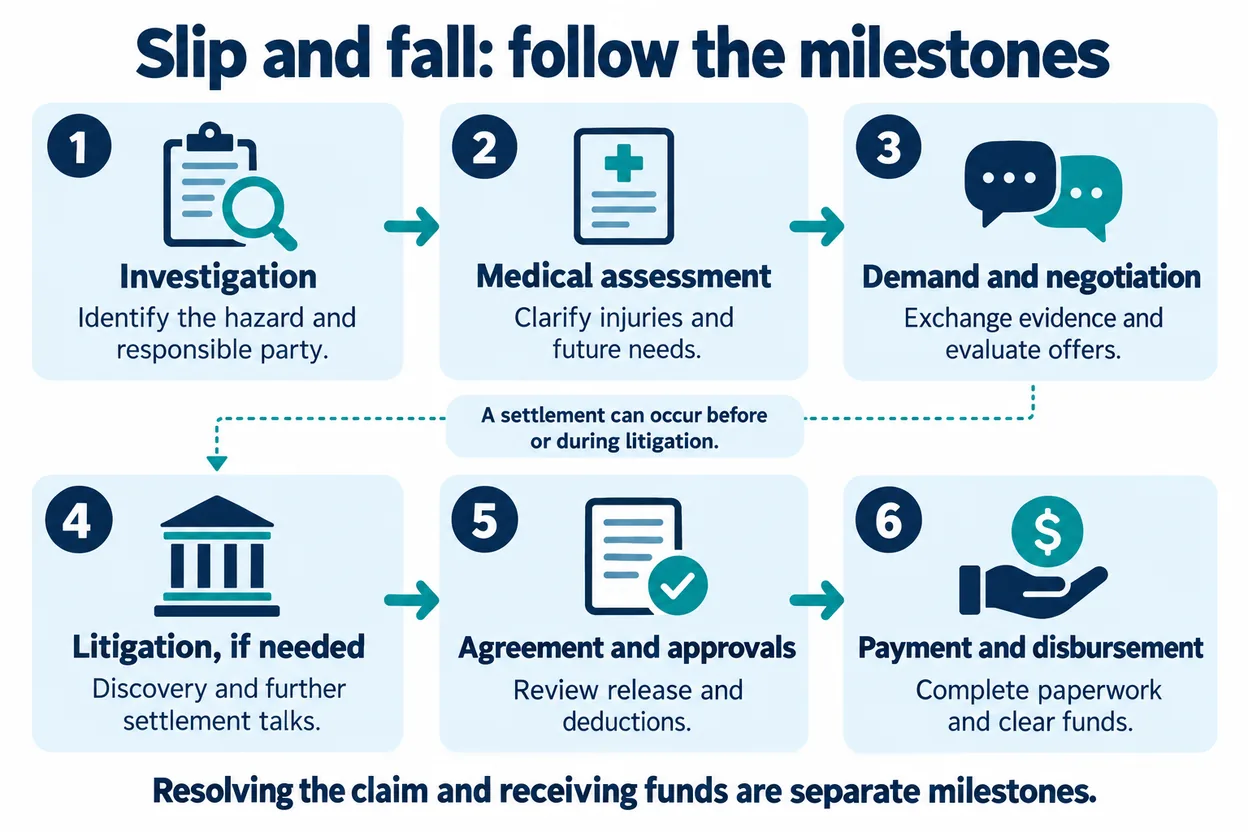
The first stage is an investigation into what caused the fall and who may be legally responsible. Counsel needs more than an injury diagnosis and a property address. Photographs, witness accounts, surveillance, maintenance arrangements and the condition’s history may show whether a viable claim exists. A landlord, tenant, management company or contractor may have different responsibilities for the same location.
Medical assessment develops alongside the liability investigation. Emergency records establish part of the early history; later examinations may clarify the injury, treatment response and future needs. Counsel can collect available records while treatment continues. Waiting for every medical question to be resolved before investigating the scene risks losing evidence.
From investigation to a demand
A demand normally presents the basis for liability and the losses supported by the available evidence. An insurer may request additional records, question how long the condition existed or dispute whether all treatment relates to the fall. Negotiation means assessing those issues and exchanging positions; it does not mean that the insurer has accepted responsibility.
If the claim does not resolve, litigation may be necessary. The New York courts’ outline of a civil case distinguishes pleadings, discovery, pretrial proceedings, trial and post-trial matters. An individual claim may settle before a lawsuit, during discovery or later. It does not have to complete every stage to settle, and filing a lawsuit does not guarantee a payment.
Agreement is a separate milestone from receipt of funds
An agreed figure may still require a signed release, proper settlement documents, any necessary court approval and arrangements for deductions. Payment must then be received and processed before the client receives the amount available for disbursement. Ask whether a status update describes a tentative offer, an accepted agreement, completed paperwork, money received or cleared funds ready for distribution. Using those distinctions makes progress easier to understand without assuming a universal timetable.
Why can proving notice or the extent of an injury take time?
Two of the most consequential uncertainties are whether the responsible party created or had notice of the hazard, and what harm the fall caused. They involve different records and different decision makers. An insurer may be satisfied that a fracture occurred while still disputing responsibility for the floor condition. Conversely, responsibility may be relatively clear while the long-term effect of an injury remains uncertain.
In Gordon v American Museum of Natural History, New York’s Court of Appeals explained that constructive notice requires a defect to be visible and apparent and to exist long enough for the defendant’s employees to discover and remedy it. General awareness that a dangerous condition might occur does not establish notice of the particular condition. That makes evidence about the period before the fall especially important.
| Outstanding issue | Potential evidence holder | What the evidence may clarify |
|---|---|---|
| How long the condition existed | Property operator, witnesses or surveillance custodian | Whether the hazard was present before the incident and for how long |
| Whether anyone received a warning | Manager, tenant or maintenance staff | The content, timing and recipient of an earlier complaint |
| Who maintained the area | Owner, tenant, manager or contractor | Relevant duties under leases, contracts and actual practices |
| Which injuries resulted from the fall | Treating providers and other relevant clinicians | Diagnosis, prior condition, treatment and the causal explanation |
| Whether future treatment is likely | Treating providers and, where needed, qualified experts | Prognosis, restrictions and support for future costs |
Identify the missing item and the next step
A useful update identifies the requested record, the person or organization holding it, the request already made and the next available step. “We need surveillance from the entrance before the incident” is more informative than “the evidence is incomplete.” Footage may never have existed, may cover a different area or may already have been overwritten; an attorney must assess alternatives rather than assume that a request will produce it.
Medical uncertainty requires a different response. Ask what clinical assessment is outstanding and why it matters to the valuation. Follow treatment recommendations for your health, report symptoms accurately and tell counsel about practical difficulties obtaining care. Do not undergo unnecessary treatment or postpone medically appropriate decisions to influence a claim. An uncertain prognosis should be explained, not converted into an unsupported prediction of either full recovery or permanent disability.
How can discovery and mediation change the settlement timeline?
Discovery gives the parties formal ways to request relevant records and testimony after litigation begins. According to the New York courts’ discovery guidance, the process can involve document requests, examinations before trial and other authorized methods. Obtaining disputed information may require objections to be resolved or a court order. A preservation request alone does not compel someone to hand over every requested record.
Discovery can change the assessment of liability
A deposition may clarify which employee inspected an aisle, what the inspection involved and whether a written log reflects an actual inspection. Contracts may clarify maintenance obligations, while photographs or testimony may contradict an earlier account of the condition. Each development can affect the parties’ assessment of the likelihood of proving a claim or defense.
For example, in a hypothetical store case, an entry saying “floor checked” may appear helpful to the defense. Testimony could reveal that the entry covered another section of the store. Alternatively, a witness may confirm a careful inspection shortly before the incident. The value of discovery lies in what it establishes, including evidence unfavorable to the injured person; the mere production of more pages is not itself progress toward a larger recovery.
Expert work can add another dependency. A specialist may need reliable measurements, medical information or other records before expressing an opinion. Counsel should explain the question an expert is being asked to address and whether the relevant materials are available.
Mediation creates an opportunity, not a guaranteed result
The court system’s ADR guidance describes mediation as a process in which a neutral helps parties work toward agreement. It differs from having a judge or jury decide the merits. A mediation can occur while litigation continues, and the case may remain unresolved afterward.
Readiness matters. A discussion may be more productive when the participants have the necessary records, understand the injury and have appropriate settlement authority. It may reveal a gap that requires further work instead. Ask counsel what decision or information the next conference, deposition or mediation is expected to produce. Neither scheduling an event nor attending it establishes a reliable payment date.
What should you review before accepting an offer and awaiting payment?
Before accepting an offer, review both what the settlement resolves and what you are likely to receive. A gross figure does not answer either question. The release may dispose of claims connected to the incident, including consequences that become clearer later. Ask your attorney to explain its scope and how uncertain future treatment or work limitations have been considered.
Review the evidence behind future losses
Distinguish medical recommendations from possibilities. A documented expectation of further surgery raises different questions from a treatment option that has not been recommended. Work limitations should also have support: a job description, medical restrictions, wage records and evidence about whether modified duties are available can matter. Counsel should explain both the evidence supporting claimed losses and significant weaknesses the other side may raise.
The net recovery depends on the actual retainer, permitted case expenses and applicable repayment obligations. The Second Department’s contingent-fee and closing-statement rule illustrates why a closing statement distinguishes the settlement, fees, expenses and deductions. The rule’s applicability and the fee calculation must be checked for the particular representation; do not assume that every New York case uses one identical calculation.
Ask for a written explanation of:
- The gross settlement and the attorney’s fee calculation.
- Itemized case expenses and how they affect that calculation.
- Known liens, reimbursement claims or other required deductions.
- Any unresolved amount being held pending clarification.
- The expected net distribution and the documents or approvals still needed.
Understand the payment conditions
CPLR §5003-a establishes settlement-payment requirements for actions within its scope. Its timing depends on the required tender of settlement documents, and different provisions or exceptions can apply, including for public defendants and certain structured settlements. An insurer’s verbal offer therefore should not be treated as the start of one universal payment clock.
Some matters also need judicial approval, including covered settlements involving an infant under CPLR §1207. Ask counsel to identify outstanding approvals, payment obligations and disbursement steps separately. If funds have arrived but a deduction remains unresolved, ask what can lawfully be distributed and what still needs to be resolved; do not assume all money is immediately available.
How can Michael Brook help you find a lawyer for a serious fall with disputed liability?
If a serious fall has left you facing disputed responsibility or stalled negotiations, we can help connect you with an attorney for an independent evaluation. Our slip and fall attorney referral service gives you a way to seek legal help with the facts of the incident, the available records and the current status of the claim.
For an initial discussion, explain where the fall happened, what condition you believe caused it and what injury was diagnosed. Mention whether the property operator received a report, whether witnesses or photographs are available and whether an insurer has made an offer. If a lawyer already represents you, disclose that relationship and any pending court dates or deadlines.
Useful questions for the attorney include who may have responsibility for the location, what evidence of creation or notice is missing and whether medical uncertainty is preventing a reliable assessment. Bring any proposed release or settlement correspondence rather than relying only on the amount quoted in a telephone call.
Michael Brook provides referrals. The referred attorney independently evaluates the matter and handles any legal work they agree to accept. A referral is not a promise of representation, settlement or a particular timetable. It also does not file a lawsuit or preserve a deadline. You can request a free consultation to discuss the next step toward finding appropriate legal assistance.
Conclusion: How can you judge whether your fall claim is progressing?
Judge progress by the question being resolved, the evidence needed and the next responsible action. An unresolved liability issue, an uncertain prognosis and incomplete settlement paperwork are different problems. Asking which one is holding up the claim makes a status conversation more useful.
| Milestone | What should be clearer | Practical next action |
|---|---|---|
| Liability investigation | The hazard, responsible parties and evidence of creation or notice | Identify missing records and preservation or discovery steps |
| Medical assessment | Diagnosis, restrictions and supported future needs | Ask which clinical information remains outstanding |
| Negotiation or mediation | The offer, disputed issues and risks of continuing | Review the evidence and the proposed resolution with counsel |
| Settlement documentation | Release terms, deductions and required approvals | Obtain an explanation of unresolved conditions |
| Payment and disbursement | Receipt of funds and the net amount available | Review the closing statement and any remaining holdback |
The Gordon decision explains why notice evidence cannot be replaced by assumptions about a property’s general condition. Court guidance on discovery explains how formal requests and testimony may address those gaps. Use those principles to ask precise questions, preserve original records and keep counsel informed of treatment and work changes. Do not allow ongoing negotiations to distract from filing or notice requirements that may continue to run.
Sources
- New York State Unified Court System: Basic steps in a court case
- New York Court of Appeals: Gordon v American Museum of Natural History
- New York State Unified Court System: Discovery
- New York State Unified Court System: Alternative dispute resolution
- Appellate Division, Second Department: §691.20 contingent-fee and closing-statement rule
- New York CPLR §5003-a: Prompt payment following settlement
- New York CPLR §1207: Settlement involving an infant or specified protected person

Injured in an accident? Michael Brook connects you with top personal injury attorneys who fight to get you the compensation you deserve. Speak with someone today — no cost, no obligation.


After being hit while crossing the street, I had no idea which lawyer to trust. Michael reviewed my situation and connected me with the right attorney immediately.

Michael explained what kind of case I had and referred me to an attorney who handled serious car accidents. That clarity changed everything.

I was injured in a fall and worried it wouldn’t be taken seriously. Michael connected me with an attorney experienced in premises liability cases.

The driver passed away, and I assumed I had no options. Michael explained how insurance works and connected me with an attorney who took action fast.