
Potentially Liable Parties in a NYC Truck Accident
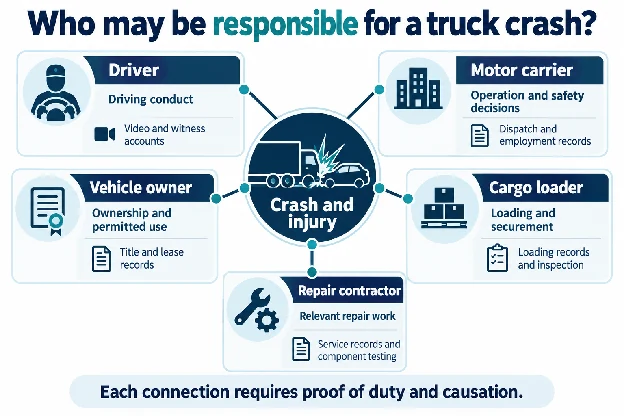
The driver is the most visible person in a truck crash, but the investigation may reach a carrier, a vehicle owner, a loader or a repair contractor. What matters is the legal duty each one had and how it connects to the collision.
The driver is often the most visible person involved in a truck crash, but the investigation may extend to a carrier, vehicle owner, loader or repair contractor. The important question is what legal responsibility each party had and how that responsibility connects to the collision and your injury.
A truck’s logo, a delivery destination or an insurance policy does not answer that question alone. Identifying the businesses is the beginning of the assessment; proving a claim requires evidence of the relevant relationship, conduct and causation.
When can the truck driver or motor carrier be responsible for a crash?
A driver may be responsible when negligent driving causes injury. The investigation could concern speed, a turn, lane position, following distance, attention or another aspect of vehicle operation. The fact that a truck was involved does not establish that its driver caused the collision. Video, witness accounts, physical evidence and the surrounding traffic conditions must be considered together.
A carrier’s potential responsibility involves a different set of questions. An employer may be legally responsible for an employee’s conduct within the relevant employment relationship. Establishing that relationship requires more than recognizing a company’s name. Counsel may examine who assigned the trip, directed the work and employed the driver, along with contracts and the actual operation.
Separate responsibility for the driver from a company’s own conduct
A claim based on an employment or agency relationship differs from an allegation that the company itself made an unsafe decision. Potential direct allegations might concern hiring, supervision, maintenance or operational instructions. Each requires an applicable duty, supporting facts and a causal connection to the crash; merely listing several allegations does not make them viable.
For example, suppose a driver reports a brake problem before a trip. An investigation might ask who received the report, what inspection or repair followed, whether the problem persisted and whether it contributed to the collision. That is different from assuming that every carrier is directly negligent whenever one of its drivers makes an error.
Contracts can help identify responsibilities, but the real working arrangement may also matter. A label such as “independent contractor” does not resolve every legal relationship or regulatory question. Likewise, a carrier’s control over transport does not automatically prove control over every separate loading or repair task.
Counsel may use the court discovery process to obtain relevant records and testimony. Ask the attorney to explain which legal theory applies to each proposed defendant and what facts remain missing. That explanation should distinguish an investigation lead from a supported allegation.
When could a vehicle owner, cargo company or repair contractor share responsibility?
Ownership, loading and maintenance can create additional lines of investigation. The tractor and trailer may have different owners, while another business may have loaded the cargo or serviced a component. Identifying those roles helps counsel decide what records to request; it does not mean that every business should be named in a lawsuit.
| Potential party | Question to investigate | Evidence that may help |
|---|---|---|
| Vehicle owner | Was the relevant use permitted, and what ownership rules apply? | Title, registration, lease and permission records |
| Cargo loader | Did a loading or securement failure contribute to the event? | Loading records, photographs, weight information and inspections |
| Repair contractor | Did negligent work affect a component involved in the crash? | Work orders, service history and component examination |
| Product manufacturer | Was there a legally actionable defect connected to the injury? | Preserved product, design or manufacturing evidence and expert analysis |
| Broker or shipper | Is there a specific actionable role beyond participation in transport? | Contracts, instructions, actual conduct and applicable law |
Ownership can matter, but exceptions matter too
New York Vehicle and Traffic Law §388 addresses an owner’s responsibility for negligent vehicle use with express or implied permission. Counsel must assess the statutory definitions and the facts. Federal law also limits liability based solely on ownership for qualifying rental and leasing businesses under specified conditions; 49 U.S.C. §30106 makes the owner’s own negligence and other statutory requirements relevant. A leased truck therefore calls for analysis rather than an automatic conclusion in either direction.
Loading and repair allegations likewise need a causal link. A shifted load may justify examining who loaded and secured it, but the investigation must determine when and why it shifted. A recent brake repair may be relevant, but its timing alone does not prove the repair was defective or caused the collision.
Do not discard or alter an allegedly defective component. Counsel can arrange a lawful inspection that preserves the opportunity for the parties to assess its condition. Testing without an agreed process may change the very evidence needed to understand the failure.
What evidence connects each party’s conduct to the collision?
Useful evidence links a business to a particular responsibility and then links the alleged failure to the crash. A bill of lading can identify participants in a shipment, for example, but may not establish who physically secured the cargo. A repair invoice can identify work performed without showing that the work was negligent. The investigation needs both the record and an explanation of what it actually proves.
Start with the relationships and sequence of events:
- Contracts and leases may identify the parties, assigned tasks and claimed control over equipment or work.
- Dispatch instructions and communications may show the assignment, route, schedule and information given to the driver.
- Inspection and maintenance records may reveal reported conditions, completed work and unresolved concerns.
- Cargo documents may identify the shipment, loading location and businesses involved.
- Vehicle data, video and witness accounts may help test whether a proposed failure fits the collision mechanism.
Preserve the records needed to test the theory
An attorney should identify who holds each record and whether it may change or disappear. For certain driver records, the FMCSA retention guidance specifies six months from receipt for records of duty status and supporting documents. That rule does not establish the retention period for every camera, message or vehicle-data system, nor does it replace litigation preservation requirements.
Preservation requests should therefore address the relevant systems and time period. A request sent only to the carrier may not reach a separately owned camera or an independent repair shop. Formal discovery may be necessary to obtain documents and testimony when voluntary access is unavailable.
Look for the missing causal step
Suppose a record establishes that a business repaired a tire before the crash. The next questions include what work was done, the tire’s later condition, whether another event caused the failure and how that failure affected the collision. Technical examination and other records may support or defeat the proposed connection.
This approach also helps avoid unsupported accusations. Evidence can establish that a business was involved while showing that a different party controlled the operation that allegedly caused harm. Counsel should revise the list of potentially responsible parties as the factual record develops.
How can shared fault and insurance disputes affect recovery?
Responsibility may be disputed among drivers and businesses, and an injured claimant’s conduct may also be at issue. The applicable fault rule matters because it can affect the amount recoverable or, in some circumstances, whether recovery is available at all. Counsel should check the law applicable to the accident and claim rather than rely on a general statement that New York always follows one rule.
The published text of CPLR §1411 contains a general proportional-reduction rule and a separate provision for personal injury actions subject to Insurance Law article 51\. Under that separate provision, claimant fault greater than the fault of the defendant, or the combined fault of the defendants against whom recovery is sought, bars recovery. The applicability of the amended provision to the accident must be checked. A statement that a claimant can always recover regardless of their share of fault is therefore unsafe.
Injury eligibility is a separate question
Insurance Law §5104 restricts recovery of non-economic loss in specified motor-vehicle cases to serious injury, while §5102 supplies the statutory definitions. Counsel must assess coverage status, the applicable version of the law and the medical proof. Evidence that another driver caused a crash does not, on its own, establish eligibility for every category of damages.
Separate damages from available payment
An insurance limit is not a valuation of your injury. The supported losses, legal liability and available coverage are distinct issues. Counsel may need to identify which policy covers which vehicle, driver or business; whether coverage is disputed; and whether other claims compete for the same available funds.
Several named companies do not necessarily mean several independent, fully available insurance limits. Conversely, the first insurer identified may not resolve the entire coverage investigation. Ask counsel what coverage has been confirmed and what remains uncertain.
Before settlement, also request an explanation of fees, expenses and applicable reimbursement claims. A gross offer can differ substantially from the amount ultimately paid to you. Liability analysis, coverage review and a clear settlement accounting should inform the decision together.
How can Michael Brook help you find counsel for a truck crash involving several parties?
When several businesses appear connected to a serious truck crash, we can help you seek an attorney with relevant commercial-vehicle experience. Michael Brook provides an attorney referral service. The referred attorney independently evaluates the facts, decides whether to accept the matter and handles any accepted legal case.
For a commercial vehicle accident attorney referral, explain where the collision occurred, your injuries and the vehicle or company identifiers you have. Mention whether the truck was towing a trailer, carrying a visible load or displaying more than one company name. These details can identify useful investigation questions without requiring you to decide who is legally responsible.
Bring available photographs, the police-report reference, insurer letters and relevant treatment records to the attorney’s consultation. If someone has asked you to sign a release or a vehicle is awaiting repair, identify that issue promptly. Do not delay seeking advice because contracts or carrier records are not yet available to you.
Questions for counsel include how the different business roles will be investigated, who will handle preservation and how liability and coverage questions will be assessed separately. Confirm whether the attorney has accepted representation and which immediate steps are included.
You can request a free consultation. A referral helps you seek suitable counsel; it does not establish a company’s liability, guarantee recovery or preserve a filing deadline by itself.
Conclusion: What must be established before naming a responsible party?
The investigation should move from identifying a party to establishing its legal role and its connection to the injury. Keep duty, alleged failure, causation and coverage separate so that a strong answer to one question does not hide a gap in another.
| Question | What a reasoned assessment needs | Common mistake to avoid |
|---|---|---|
| What duty applied? | The party’s role, relationships and governing law | Treating a company logo as proof of responsibility |
| What went wrong? | Evidence of the alleged conduct or failure | Assuming involvement means negligence |
| Did it cause harm? | A supported connection between the failure, collision and injury | Relying only on the timing of a repair or delivery |
| What can be recovered? | Applicable fault and injury rules, supported damages and confirmed coverage | Treating a policy limit as the value of the case |
Preserve records promptly, including those held outside the carrier’s own systems. Use lawful discovery where necessary, and ask counsel to explain the applicable motor-vehicle fault and injury rules before assessing settlement options. An expanding list of companies is less useful than a clear account of what the evidence supports against each one.
Sources

Injured in an accident? Michael Brook connects you with top personal injury attorneys who fight to get you the compensation you deserve. Speak with someone today — no cost, no obligation.

After being hit while crossing the street, I had no idea which lawyer to trust. Michael reviewed my situation and connected me with the right attorney immediately.

Michael explained what kind of case I had and referred me to an attorney who handled serious car accidents. That clarity changed everything.

I was injured in a fall and worried it wouldn’t be taken seriously. Michael connected me with an attorney experienced in premises liability cases.

The driver passed away, and I assumed I had no options. Michael explained how insurance works and connected me with an attorney who took action fast.