
Workers’ Compensation and Personal Injury Claims After a NYC Construction Accident
A fall from a scaffold can leave you dealing with two different questions: who will pay for treatment now, and whether someone outside your employer is legally responsible for the injury. Those questions may lead to separate claims, and starting one does not automatically resolve the other.
A fall from a scaffold can leave you dealing with two different questions: who will pay for treatment now, and whether someone outside your employer is legally responsible for the injury. Those questions may lead to separate claims. Starting one does not automatically resolve the other.
For a seriously injured construction worker, the immediate priorities are treatment, timely reporting and preservation of evidence. A lawyer can then assess whether workers’ compensation, a third-party lawsuit or both apply, and how any recovery would affect ongoing benefits.
How do workers’ compensation and personal injury claims differ after a construction accident?
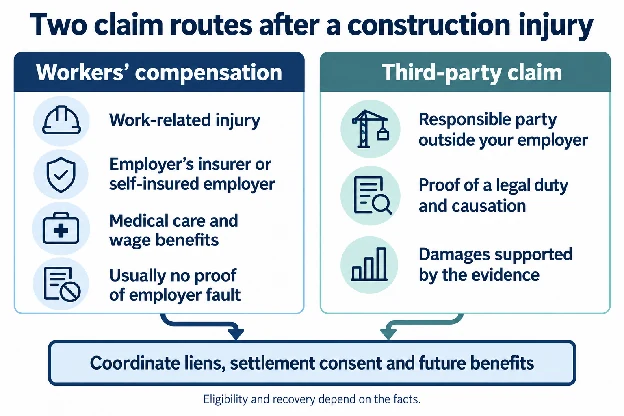
Workers’ compensation is a benefits system for eligible work-related injuries. You generally do not have to prove that your employer negligently caused the accident. You do need evidence connecting the injury to your work, along with the medical and employment information needed to establish benefits. An insurer can dispute that connection, the extent of disability or a treatment request, so a benefits claim is not automatically accepted simply because an incident report exists.
The New York Workers’ Compensation Board’s injured-worker guidance describes medical care and partial wage replacement. Wage benefits depend on factors such as average weekly earnings and disability, subject to applicable limits. They are not a promise to replace every dollar of take-home pay. Workers’ compensation also does not provide the same pain-and-suffering damages that may be available in a civil injury case.
A personal injury claim asks a different question: did a legally responsible third party cause compensable harm? Depending on the facts, that party could be a property owner, contractor outside your employer, equipment manufacturer or another business. Counsel must identify the applicable duty, the failure or statutory violation alleged, its connection to the accident and the resulting losses. Being present at the site does not, by itself, make a company liable.
The employer boundary
An employer that provides required workers’ compensation coverage is usually protected from an employee’s ordinary injury lawsuit. Exceptions and employment relationships need individual review. The practical consequence is that a worker should identify every company involved, rather than assume the company name on a hard hat establishes who employed whom.
A civil claim may seek supported losses beyond compensation benefits, including pain and suffering and future economic harm. It also requires a separate liability and damages assessment. Neither a severe diagnosis nor payment of workers’ compensation proves that a third-party lawsuit will succeed. Conversely, the absence of a viable lawsuit does not necessarily defeat a benefits claim.
When can an injured worker pursue both types of claim?
Consider a worker employed by a framing subcontractor who is injured when equipment operated by a different contractor strikes them. The employment-related injury may support a workers’ compensation claim. A separate investigation would ask who controlled the equipment, what its operator did and whether that conduct caused the injury. The worker would not need to abandon benefits merely to investigate that other company’s responsibility.
Workers’ Compensation Law § 29 provides the framework for pursuing remedies against someone outside the same employment while receiving compensation. The statute also creates coordination obligations. It should not be read as permission to collect every claimed loss twice or settle one proceeding without considering the other.
| Possible situation | Question a lawyer must resolve | Useful evidence |
|---|---|---|
| A different contractor operates the equipment | Did that contractor’s conduct cause the incident? | Operator identity, daily reports, video and witness accounts |
| A ladder or scaffold fails | Does an applicable Labor Law duty cover the work and hazard? | Equipment photographs, task description and safety-device information |
| A tool has an alleged defect | Was there a defect, and did it cause the injury? | Preserved tool, model information, maintenance history and expert inspection |
| Companies disagree about employment | Is a proposed defendant actually protected by an employment relationship? | Payroll records, contracts and evidence of supervision |
Construction claims may involve Labor Law § 240, which addresses specified work and protective devices. Its application depends on the work, the elevation-related risk, the parties’ roles and causation. A fall at a construction site is not enough to establish every element. Other duties may apply to other hazards, but counsel must match the facts to the correct rule.
Before an initial consultation, write down your employer’s name, the site address, the task you were performing and the companies you remember. If you do not know which business owned a machine, say so. A photograph of a logo or equipment number can help the lawyer investigate without turning a guess into a factual allegation.
How can a third-party settlement affect workers’ compensation benefits?
A settlement offer must be examined alongside benefits already paid and benefits that may become payable. The number at the top of an offer is a gross amount. The worker’s eventual payment may be affected by legal fees, litigation expenses, reimbursement claims and other legally applicable deductions.
Under Workers’ Compensation Law § 29, a compensation carrier can have a lien against a third-party recovery, subject to statutory rules and allocation of recovery costs. A lien is a claim to reimbursement from the recovery; it is not necessarily the same as every figure in an insurer’s initial letter. Counsel should obtain the payment history and determine which amounts are legally recoverable before negotiating or approving an accounting.
Consent and future benefits
Do not sign a third-party release without advice about workers’ compensation coordination. The law contains settlement-consent and court-approval provisions. Failure to satisfy the applicable requirements can jeopardize continued compensation rights. The lawyer handling the lawsuit and the representative handling benefits should know about each other’s proceedings and communicate before settlement documents are signed.
The effect can extend beyond repayment for the past. A third-party recovery may affect when the carrier must resume future payments. That future-benefit issue deserves attention if you expect additional surgery, a lengthy period away from work or continuing disability. An offer that appears attractive when viewed only as cash today may have different consequences once ongoing benefits are considered.
Ask counsel to explain the proposed settlement in an itemized statement:
- What is the gross recovery, and what legal fee and expenses are deducted?
- Which reimbursement claims are asserted, and which amounts have been agreed or remain disputed?
- What consent or approval is required before the settlement can proceed?
- How will the recovery affect future medical or wage benefits?
- What amount can be paid to you, and what must remain reserved?
These are coordination questions, not reasons to reject every offer. A properly evaluated settlement can account for them. The essential step is to understand the consequences before a release becomes binding, rather than discover a benefits problem after the money has been allocated.
Which records and deadlines should you address first?
Begin with medical attention and an accurate report of how the injury happened. Tell treating clinicians that the incident occurred at work. Save discharge instructions, appointment information and work restrictions. If you cannot collect site information because you are hospitalized, a relative can help organize documents while a lawyer considers preservation requests.
The Workers’ Compensation Board identifies two different steps: notifying the employer and filing a claim with the Board. Its guidance calls for written employer notice as soon as possible, ordinarily within 30 days, and filing the employee’s claim within two years of the accident. Form C-3 is the employee claim form. An employer’s internal incident report is not a reason to assume your own filing has been completed.
Keep a copy of each submission and evidence of delivery. A phone conversation can be useful, but a retained email or document provides a clearer record of what was reported and when. If a deadline may already have passed, seek advice promptly about the facts and any available exception; do not decide on your own that every possible claim is lost.
Keep separate deadlines separate
The benefits timetable does not determine every lawsuit deadline. Third-party litigation, statutory coordination notices and claims involving public entities require separate review. General Municipal Law § 50-e ordinarily requires a notice of claim within 90 days where that statute applies. Identifying a public owner or contractor does not answer every notice question: the correct entity, claim and service method matter.
Prepare the following without returning to an unsafe area:
- Employer, site address, accident date and the task being performed.
- Witness names and reliable contact details.
- Original photographs showing the equipment, condition and wider location.
- Incident reports, employer notices and Board or insurer correspondence.
- Treatment records, work restrictions, wage records and benefit-payment notices.
Preserve originals and note who created each record. Do not repair, discard or test an allegedly defective tool yourself. Early legal review is particularly useful when equipment may be moved, surveillance may be overwritten or the identity of a responsible company is uncertain.
How can Michael Brook help you find counsel for a serious construction injury?
If your injury involves hospitalization, fractures, lasting limitations or possible responsibility beyond your employer, we can help you find an attorney whose experience fits the problem. Our construction injury attorney referral service connects seriously injured workers with lawyers who handle construction accident matters.
When you contact us, explain the task, location, injury and any companies you can identify. Mention whether you have already filed for workers’ compensation, retained a representative or received a settlement document. Those details help distinguish a benefits question from a possible third-party case and identify issues that need prompt attention.
Michael Brook provides referrals. The referred attorney independently evaluates the facts, decides whether to accept the matter and handles the legal work for any accepted case. A referral does not establish liability, guarantee representation or extend a filing deadline.
You can request a free consultation before every record has arrived. Bring what you have and identify what is missing. Ask the attorney whether both claim routes need review, who will manage each one and how communications about liens and settlement consent will be coordinated.
Conclusion: What should you clarify before choosing a claim route?
The useful starting point is to establish what each procedure can address and where they overlap. Preserve your benefits claim while a qualified lawyer investigates any third-party responsibility. If both proceed, make coordination part of the case from the outset.
| Decision | Workers’ compensation | Third-party injury claim |
|---|---|---|
| Main eligibility question | Is the injury covered and work-related? | Did a legally responsible third party cause the injury? |
| Main recovery question | Which medical and wage benefits are payable? | Which supported damages are legally recoverable? |
| Immediate paperwork | Employer notice and Board claim | Evidence preservation and lawsuit or notice review |
| Before settlement | Review future benefit consequences | Resolve consent, liens and the net accounting |
Tell each lawyer about the other proceeding. Share carrier letters, offers and proposed releases before signing them. That allows the legal assessment to address the recovery as a whole, including treatment needs and the amount actually available to you.
Sources

Injured in an accident? Michael Brook connects you with top personal injury attorneys who fight to get you the compensation you deserve. Speak with someone today — no cost, no obligation.

After being hit while crossing the street, I had no idea which lawyer to trust. Michael reviewed my situation and connected me with the right attorney immediately.

Michael explained what kind of case I had and referred me to an attorney who handled serious car accidents. That clarity changed everything.

I was injured in a fall and worried it wouldn’t be taken seriously. Michael connected me with an attorney experienced in premises liability cases.

The driver passed away, and I assumed I had no options. Michael explained how insurance works and connected me with an attorney who took action fast.